Editor's Pick

Brink of Oblivion: The Fragile Calm Before the Islamabad Resumption

Brink of Oblivion: The Fragile Calm Before the Islamabad Resumption

ISLAMABAD — The world holds its breath as the clock ticks toward midnight on Wednesday, April 22, the scheduled expiration of a tense 14-day ceasefire in the 2026 Iran War. While the streets of Islamabad are lined with paramilitary patrols in anticipation of a second round of peace talks, the diplomatic atmosphere is thick with the scent of cordite and mutual distrust.

The conflict, which has pitted the combined military might of the United States and Israel against the Islamic Republic, reached a stalemate earlier this month. However, the "peace" currently observed is paper-thin. As both sides prepare to return to the negotiating table in Pakistan, the stakes have shifted from regional dominance to global economic survival.

The Collapse of Round One

The first round of talks, held at Islamabad’s Serena Hotel on April 11–12, ended in a bitter deadlock after 21 hours of marathon negotiations. Led by U.S. Vice President JD Vance and Iranian representatives, the sessions fractured over two non-negotiable pillars:

    The Hormuz Dilemma: The U.S. demanded an unconditional reopening of the Strait of Hormuz to restore global oil flow. Iran countered with a demand for the immediate lifting of all primary and secondary sanctions.

    Nuclear Redlines: Washington insisted on the full removal of enriched uranium stockpiles. Tehran, citing "Operation Midnight Hammer" (the recent U.S. strikes on its nuclear facilities), has refused to budge on what it calls its sovereign right to enrichment.

In the wake of this failure, President Donald Trump imposed a total naval blockade on Iranian ports, a move Tehran has labeled an "act of total war."

A Fragile Ceasefire Under Fire

Despite the official cessation of hostilities on April 8, the "ceasefire" has been anything but quiet. Iran has accused Israel of violating the pact via Operation Eternal Darkness, a massive series of airstrikes in Southern Lebanon. Israel maintains these strikes target Hezbollah assets not covered by the Iran-specific agreement.

    "We do not accept negotiations under the shadow of threats," stated Iranian Parliament Speaker Mohammad Bagher Ghalibaf. "If clashes resume, Iran is ready to show new cards on the battlefield."

The Road to Round Two

As of today, April 21, the resumption of talks remains perilously uncertain. While U.S. officials express "measured optimism," the Iranian delegation has yet to depart for Islamabad, citing American "bad faith."

The 14-Day Ceasefire Begins
April 8, 2026

Mediated by Pakistan, the U.S., Israel, and Iran agree to halt direct kinetic strikes to allow for diplomatic cooling.

First Islamabad Talks Fail
April 12, 2026

Negotiations collapse after 21 hours. JD Vance departs without a Memorandum of Understanding.

Naval Blockade Imposed
April 13, 2026

President Trump announces a total blockade of Iranian maritime trade, driving Brent crude above $95/barrel.

Ceasefire Expiration Deadline
April 22, 2026

The current truce ends at midnight. Trump warns that "lots of bombs" will follow if no deal is reached.

What to Expect in the Coming Days

If the second round proceeds, the mediators—led by Pakistani Prime Minister Shehbaz Sharif—are expected to propose a "Two-Phase Framework." This would involve a 45-day extended ceasefire in exchange for a partial reopening of the Strait of Hormuz and limited sanctions relief.

However, the shadow of a wider regional conflagration looms large. With the International Energy Agency (IEA) warning of the "biggest energy crisis in history," the delegates in Islamabad aren't just negotiating the fate of three nations—they are negotiating the stability of the global economy.

India: the 6th largest economy in the world by Nominal GDP

India: the 6th largest economy in the world by Nominal GDP

As of April 2026, India is the 6th largest economy in the world by Nominal GDP.

While India briefly held the 4th and 5th spots in recent years, recent shifts in exchange rates and statistical updates have adjusted its current standing. However, it remains the fastest-growing major economy globally.

Global Rankings (Nominal GDP, 2026)

The International Monetary Fund (IMF) April 2026 World Economic Outlook ranks the top economies as follows:

1    United States    $32.38 Trillion   Holding steady
2    China    $20.85 Trillion   Slowing growth
3    Germany    $5.45 Trillion   High energy costs
4    Japan    $4.38 Trillion   Reclaimed rank from India
5    United Kingdom    $4.26   Trillion Reclaimed rank from India
6    India    $4.15 Trillion   Fastest major growth (6.5%)

Why did India slip to 6th?

It is important to note that this isn't due to a domestic slowdown. Economists point to two technical reasons:

    Currency Depreciation: The Indian Rupee (INR) has depreciated against the US Dollar (reaching around ₹92–₹94/$). Since global rankings are measured in USD, a weaker rupee "shrinks" the dollar value of the economy, even as the country grows in real terms.

    Base Year Revision: India recently updated its GDP base year calculations. This refined methodology resulted in a slightly lower nominal GDP figure in dollar terms compared to previous older-model projections.

The PPP Advantage

When looking at Purchasing Power Parity (PPP)—which adjusts for the cost of living and local buying power—India is much higher. In this category, India is the 3rd largest economy in the world, trailing only China and the United States.

Future Outlook

Despite the current "speed bump" in nominal rankings, India’s trajectory remains strong:

    Growth Rate: Projected at 6.5% for 2026, significantly higher than the UK (0.8%) or Japan (0.7%).

    Goal: Economists expect India to regain the 4th spot by 2027 and reach the 3rd spot by 2030–2031.

While India is a massive economy in aggregate, its GDP per capita remains lower at approximately $2,813, reflecting the challenge of distributing that wealth across a population of 1.4 billion.

Sharm el-Sheikh summit: Trump repeats Gaza war over, thanks mediators for ‘breakthrough’

Sharm el-Sheikh summit: Trump repeats Gaza war over, thanks mediators for ‘breakthrough’ 

Monday, Oct 13, 2025 

At the Gaza peace summit in Sharm el-Sheikh, Egyptian President Abdel Fattah el-Sisi thanked US President Donald Trump and the leaders of Qatar and Turkiye for their mediation efforts, reaffirming support for a Gaza peace plan aimed at achieving a two-state solution.
 
Trump hailed the Gaza ceasefire as “historic,” declaring that the war was over and aid was now reaching civilians. 
He praised Arab and Muslim nations for helping secure the truce, expressing gratitude to el-Sisi, who awarded him Egypt’s highest honour, and to Qatar’s Sheikh Tamim.
 
Trump also commended Turkish President Erdogan, Saudi Crown Prince Mohammed bin Salman, and UAE President Sheikh Mohamed bin Zayed for their roles. 

He said the 20-point peace plan would form the foundation for a “great and lasting peace,” calling for Gaza’s staged demilitarisation and large-scale reconstruction.

Gaza peace summit: Trump, regional leaders sign document

Gaza peace summit: Trump, regional leaders sign document 

Monday, Oct 13, 2025 

US President Donald Trump opened the Sharm el-Sheikh "Gaza peace summit" by praising the leaders of Qatar, Turkiye and Egypt for their mediation efforts to end the war in Gaza, describing Egyptian President Abdel Fattah el-Sisi as a "fantastic man" and "fantastic general." 

Trump said the ceasefire between Israel and Hamas was "working out incredibly well," calling it an unprecedented achievement "thousands of years in the making." 

He announced that a comprehensive document outlining "rules and regulations" for peace was being signed by himself, el-Sisi, Turkish President Erdogan, and Qatar’s Sheikh Tamim. No further details about the agreement were immediately released, though Trump insisted, "It’s going to hold up."

Will Trump do something to stop Israel’s genocide in Gaza?

Will Trump do something to stop Israel’s genocide in Gaza?

May 17, 2025
United States President Donald Trump's tour of the Middle East this week is his first international trip since he started his second term. Conspicuously absent from his itinerary, however, was Washington’s closest ally in the region: Israel.

A growing rift between Trump and Israeli Prime Minister Benjamin Netanyahu.

Contributors:
Diana Buttu – Human rights lawyer and analyst
Dana Mills – Writer, +972 magazine and Local Call
Jeremy Scahill – Cofounder, Drop Site News

On our radar:

Tariq Nafi reports on the killing this week of one of Gaza’s best-known journalists - and why it represents a new low in Israel’s unparalleled war on the press.

Are India’s news channels helping or harming?

The tit-for-tat conflict between India and Pakistan lasted only a week before a ceasefire deal was reached, but it was long enough to provide an insight into the role the media might play in a longer war.

We speak with Indian journalist Hartosh Singh Bal about mainstream media under Prime Minister Narendra Modi's government - from misinformation to hate speech - and the alternative news outlets trying to provide the antidote.

Featuring:
Hartosh Singh Bal – Executive editor, The Caravan magazine

‘We must adopt an Arab plan to end the war’: PA President Abbas

‘We must adopt an Arab plan to end the war’: PA President Abbas

May 17, 2025
Mahmoud Abbas, the president of the Palestinian Authority, has now also addressed the Arab League summit in Baghdad.

Here are some of his remarks:

Israeli actions in Gaza and the West Bank “are all part of a complete imperial enterprise [aimed] at undermining our efforts for establishing our independent state”.

We need support from “the Arab states, the US administration and the [UN] Security Council to stand up to this imperial enterprise”.

“[We must] adopt an Arab plan to end the war, establish peace, including the following: first, a permanent ceasefire, immediate release of all Palestinian detainees and Israeli captives, and the unconditional delivery of relief aid, in addition to the total withdrawal by the Israeli occupation forces from the Gaza Strip.”

Hamas and all other factions should “lay down and hand over their arms to the Palestinian Authority, the sole representative of the Palestinian people”.

An international conference should “be convened in Egypt for the implementation of the reconstruction plan in the Gaza Strip”.

We want an immediate end to Israel’s “confiscation, annexation and change of the historic and legal status in the Holy sites in Jerusalem”.

We want “the establishment of the Palestinian state on the Palestinian territories with full recognition by the world community”

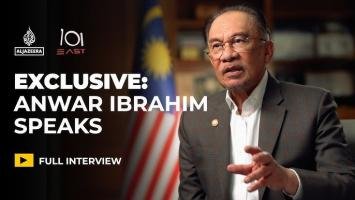
Politics & diplomacy: Exclusive Interview with Malaysia's Anwar Ibrahim

Politics & diplomacy: Exclusive Interview with Malaysia's Anwar Ibrahim

May 15, 2025
Anwar Ibrahim came to power in Malaysia soon after ex-PM Najib Razak was jailed for his role in the $4.5bn 1MDB financial scandal.

He has faced criticism after a royal pardon slashed Najib’s sentence while alleged 1MDB mastermind, Jho Low, remains at large.

Anwar leads ASEAN this year as it confronts Donald Trump’s tariffs and rising transnational crime, including a cyber-scam industry in Cambodia worth billions of dollars.

In a 101 East exclusive, Anwar Ibrahim speaks about politics and corruption in Malaysia and his conversations with Cambodia’s PM Hun Manet before the controversial deportation of domestic worker, Nuon Thoeun.

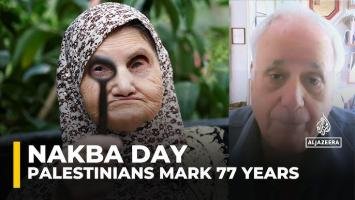
Israeli leaders trying to complete the Nakba through their actions in Gaza, West Bank: Analysis

Israeli leaders trying to complete the Nakba through their actions in Gaza, West Bank: Analysis

May 15, 2025  
Every year on May 15, Palestinians mark Nakba Day to commemorate the ethnic cleansing of Palestine upon the creation of the State of Israel in 1948.

Zionist forces expelled about 750,000 Palestinians from their homes and lands between 1947 and 1949, capturing 78 percent of historical Palestine.

Today, Palestinians and their supporters commemorate the Nakba – “catastrophe” in Arabic – with marches, protests and other events.

As Israel continues its deadly military bombardment of Gaza and tries to push Palestinians out of the coastal enclave, many observers say the Nakba never ended.

Ilan Pappe is the Chair of The Nakba Memorial Foundation and an Expatriate Israeli Historian.

He says Israeli leaders are trying to complete the Nakba, through their actions in Gaza and the occupied West Bank.

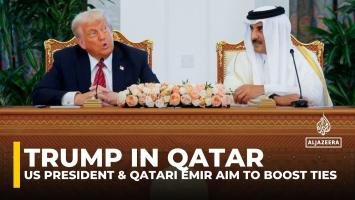
Another level: Qatar, US sign deals to boost defence and trade ties

Another level: Qatar, US sign deals to boost defence and trade ties

May 14, 2025  
Donald Trump has made history as the first sitting US president to undertake an official state visit to Qatar. During talks with Emir Sheikh Tamim bin Hamad Al Thani, the leaders signed multiple agreements to bolster trade and defence cooperation, including a landmark $200bn commercial jet deal.

For analysis, we’re joined by Omar Rahman, Fellow at the Middle East Council on Global Affairs, and Faisal al-Mudahka, Editor-in-Chief of Gulf Times, both here in the studio. Our correspondents James Bays and Kimberly Halkett are reporting live from Doha, with James stationed at the Qatari Emiri Diwan.

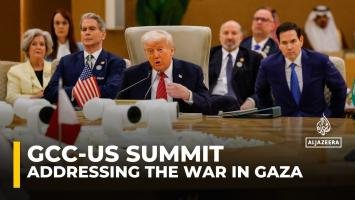
GCC summit shows assertive leadership, but lacks urgency on Gaza: Analysis

GCC summit shows assertive leadership, but lacks urgency on Gaza: Analysis

May 14, 2025
US President Donald Trump is engaged in a flurry of diplomatic activities in the Middle East as part of his three-nation tour.
 
On his second day, Trump has met the leaders of the Gulf Cooperation Council in Riyadh.

He addressed a wide range of regional issues during his speech at the summit.

Trump told the council of his plans to negotiate with Iran.

In his speech, Saudi Crown Prince Mohammed bin Salman has asked Trump to cooperate with GCC countries to deescalate tensions in Middle East.   

The Emir of Kuwait also expressed his hope that the GCC, working with the United States, can help bring about greater stability in the region, with a focus on Palestine.

Abdulaziz al-Ghashian is a Senior Non-Resident Fellow at the Gulf International Forum and Specialist on Saudi Arabia's Foreign policy and Gulf-Israel relations and Sultan Barakat is Professor of Public Policy at Hamad Bin Khalifa University.