Economy

Analysis of the global economic impact of the 2026 Strait of Hormuz blockade and current oil price projections

Analysis of the global economic impact of the 2026 Strait of Hormuz blockade and current oil price projections

The 2026 maritime blockade of the Strait of Hormuz has triggered what the International Energy Agency (IEA) calls the "greatest global energy security challenge in history." As of April 22, the global economy is caught in a high-stakes waiting game between the expiration of a 14-day ceasefire and the uncertain resumption of talks in Islamabad.

The Economic Tsunami: A Supply Shock Without Precedent

The blockade has effectively stranded approximately 21 million barrels of oil per day—roughly 20% of the world’s supply—and significant volumes of Liquified Natural Gas (LNG). Unlike previous shocks, this crisis has hit "energy-intensive" manufacturing and food security simultaneously.

    Manufacturing Paralysis: In the EU and UK, chemical and steel manufacturers have imposed surcharges of up to 30%. Analysts warn of "permanent deindustrialization" in sectors unable to absorb surging feedstock costs.

    The "Grocery Emergency": Gulf Cooperation Council (GCC) states, which rely on the Strait for 80% of their food imports, saw staple prices jump 40–120% in mid-March, forcing emergency airlifts of basic goods.

    GDP & Inflation: Modeling suggests a sustained closure could slash global GDP by $2 trillion in the first year alone. Inflation forecasts for 2026 have been revised upward by 8-15% across major energy-importing economies like Japan, South Korea, and the EU.

Oil Price Projections: The " Islamabad Premium"

Market volatility is currently driven by the " Islamabad Premium"—the price fluctuations based on the perceived success or failure of diplomatic efforts.

Scenario    Projected Brent Price    Economic Impact
Ceasefire Extension    US $85 – $95    Temporary stabilization; markets remain on edge.

Failed Talks / Blockade Persists    US $110 – $130    Inventory losses reach 1.7 billion barrels; deepening recession.

Full Kinetic Escalation    US $200 – $300+    "Demand destruction" begins; collapse of discretionary transport.

Current Status: Brent Crude is currently hovering around US $100.48, up 2% today following reports of Iran intercepting two vessels (the MSC Francesca and Epaminodes) despite the standing ceasefire.

The Diplomatic Standoff in Islamabad

The second of talks would not be hold primarily because the U.S. naval blockade, imposed by President Trump on April 13, 2026 is viewed by Tehran as a violation of the ceasefire's spirit.

    "No clear prospect for productive negotiations is foreseen under current conditions," stated an IRNA report on April 20, labeling U.S. talk of a deal as a "media game."

Roadblocks to Round Two

While U.S. Vice President JD Vance is prepared to lead the American team, the Iranian delegation has yet to arrive in Islamabad. The sticking points remain:

    Sovereignty vs. Security: Iran demands the immediate lifting of the naval blockade before substantive talks.

    The "Unified Proposal": President Trump has extended the ceasefire since midnight tonight (April 22, 2026) unlimited time to allow Iran to present a "unified proposal," but has warned that the blockade will remain until a final agreement is signed.

The failure of the " Islamabad II" talks would likely trigger an immediate return to kinetic operations, with markets prepared to "pivot toward a protracted disruption scenario."

India: the 6th largest economy in the world by Nominal GDP

India: the 6th largest economy in the world by Nominal GDP

As of April 2026, India is the 6th largest economy in the world by Nominal GDP.

While India briefly held the 4th and 5th spots in recent years, recent shifts in exchange rates and statistical updates have adjusted its current standing. However, it remains the fastest-growing major economy globally.

Global Rankings (Nominal GDP, 2026)

The International Monetary Fund (IMF) April 2026 World Economic Outlook ranks the top economies as follows:

1    United States    $32.38 Trillion   Holding steady
2    China    $20.85 Trillion   Slowing growth
3    Germany    $5.45 Trillion   High energy costs
4    Japan    $4.38 Trillion   Reclaimed rank from India
5    United Kingdom    $4.26   Trillion Reclaimed rank from India
6    India    $4.15 Trillion   Fastest major growth (6.5%)

Why did India slip to 6th?

It is important to note that this isn't due to a domestic slowdown. Economists point to two technical reasons:

    Currency Depreciation: The Indian Rupee (INR) has depreciated against the US Dollar (reaching around ₹92–₹94/$). Since global rankings are measured in USD, a weaker rupee "shrinks" the dollar value of the economy, even as the country grows in real terms.

    Base Year Revision: India recently updated its GDP base year calculations. This refined methodology resulted in a slightly lower nominal GDP figure in dollar terms compared to previous older-model projections.

The PPP Advantage

When looking at Purchasing Power Parity (PPP)—which adjusts for the cost of living and local buying power—India is much higher. In this category, India is the 3rd largest economy in the world, trailing only China and the United States.

Future Outlook

Despite the current "speed bump" in nominal rankings, India’s trajectory remains strong:

    Growth Rate: Projected at 6.5% for 2026, significantly higher than the UK (0.8%) or Japan (0.7%).

    Goal: Economists expect India to regain the 4th spot by 2027 and reach the 3rd spot by 2030–2031.

While India is a massive economy in aggregate, its GDP per capita remains lower at approximately $2,813, reflecting the challenge of distributing that wealth across a population of 1.4 billion.

Meme warfare in Trump’s battle with Beijing

Meme warfare in Trump’s battle with Beijing

Saturday, Apr 19, 2025
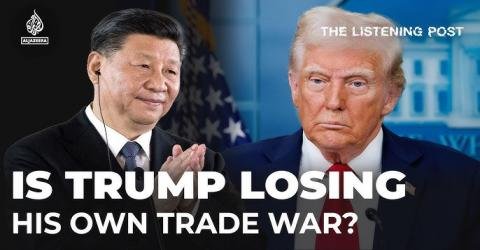
A trade war that pits the world’s two largest economies against each other is now under way. Alongside the tariff battle is a heated battle of narratives and messages between the two countries.

Contributors:
Andy Mok - Senior Research Fellow, Center for China and Globalisation
Jude Russo - Managing Editor, The American Conservative
Isaac Stone Fish - CEO, Strategy Risks
Yun Sun - Director of China Program, Stimson Center

On our radar

On April 15, the civil war in Sudan hit the two-year mark. The Sudanese media landscape has been devastated. According to Reporters Without Borders, since the war began, nearly 450 journalists have fled the country. Meenakshi Ravi has more.

How Trump’s '51st state' talk galvanised Canadian voters

Donald Trump’s public musings about how Canada should become the United States’ 51st state, has Canadians rallying around their flag. The Listening Post’s Ryan Kohls discusses the Trump effect and the unprecedented impact it is having on Canadian nationalism and politics.

Featuring:
Rachel Gilmore – Host, Bubble Pop
Jonathan Kay – Editor, Quillette
David Moscrop – Author and Journalist

What is behind Trump's U-turn on tariffs?

What is behind Trump's U-turn on tariffs?

Thursday, Apr 10, 2025  
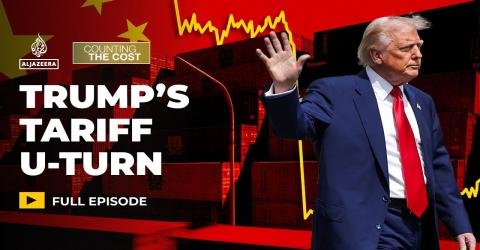
In a dramatic change of policy, Donald Trump has paused his so-called "reciprocal" levies on most nations for 90 days.

This, after his tariff policy sent markets globally into a freefall and left business leaders and even pro-Trump Republicans warning of a recession.

While the White House will be looking to cut deals with other nations on the levies, Trump has ramped up his trade dispute with China.

His decision to reverse course may have brought relief to markets.

But, with Trump's series of reversals since taking office in January, critics say uncertainty remains hanging over the United States economy.

How will US tech firms react to DeepSeek?

How will US tech firms react to DeepSeek?

Wednesday, January 29, 2025  
Investors have poured billions of dollars into artificial intelligence research and development over the past year, hoping to capitalise on this rapidly advancing technology.

Generative AI could automate countless tasks and change how many sectors do business.
 
The US has largely led this revolution but now a Chinese rival has emerged.

DeepSeek's models are faster, smaller and a lot cheaper.

Will investors still be willing to put up billions if a more cost-effective alternative exists?

And who is in the best position to benefit from AI's vast potential?

Presenter: Elizabeth Puranam

Guests:
R Ray" Wang -- CEO and principal analyst of Constellation Research, a technology research and advisory firm in Silicon Valley

Toby Walsh -- Professor of AI at the University of New South Wales and author of "Faking It: AI in a Human World".
 
Brian Wong - Independent geopolitical strategist and fellow at the Centre on Contemporary China and the World.

Kenyan President withdraws controversial finance bill after violent protests

Kenyan President withdraws controversial finance bill after violent protests

Wednesday, June 26, 2024

The government has bowed down after several days of protests in Kenya. Kenyan President William Ruto has said that he will withdraw the controversial finance bill, which had provisions for tax hike.

This decision has been taken by President William Ruto after violent protests spread in Kenya.

Kenyan President William Ruto said that he will withdraw the finance bill which contains these provisions.

Under these provisions, 16 percent sales tax was to be imposed on bread and 25 percent duty on cooking oil.

Vehicles were to be taxed at 2.5 percent of their price. There was also a plan to increase tax on financial transactions. This would have made the life of ordinary Kenyans very difficult.

Addressing the people of Kenya, William Ruto said that it has become clear that the people of Kenya did not want anything from this bill. Saying that he would not sign the bill into law, William Ruto said, "I admit defeat."

There was a controversy in Kenya over the government's new finance bill and protests took place for several days, but as soon as it was passed in Parliament, the protests took a violent turn.

22 people were confirmed dead in the violent protests on Tuesday, 25 June 2024. Kenya's National Human Rights Commission has said that so far 22 people have died in violent protests against this bill.

President William Ruto has said that he will now talk to the youth of the country, who led the biggest demonstration since the year 2022.

Despite protests across the country, Kenya's Parliament passed the controversial finance bill.

After the bill was passed, the protests took a violent turn and the protesters also entered the Parliament, where they committed arson. People protesting against the provisions also burnt a part of the Kenyan Parliament.

Initially, President Ruto was also seen dealing with these protests strictly. Even the army was deployed to stop the protesters, however, seeing the massive protest of the people, the President softened and announced the withdrawal of the bill.

The bill introduced by the government was aimed at reducing the debt of 80 billion dollars on the country, which affects Kenya's annual tax.

Ruto said that the new provisions could have proved beneficial for farmers, students and teachers but he admitted that people were not standing with him. He said, "I lead the people and they have said their point."

There is a discussion on social media in Kenya that the current protests are going to continue. Earlier, the purpose of these protests was that the President should not sign the controversial finance bill but now it is being demanded that he should resign.

Dutch parent company sells Russian unit of Yandex, known as 'Google of Russia'

Dutch parent company sells Russian unit of Yandex, known as 'Google of Russia'

Tuesday, 6 February 2024

The owner of Yandex, known as 'Russia's Google', has said that the company has sold its Russian operations.

Yandex's Dutch parent company said it has sold its Russia operation for 475 billion rubles. This price is much lower than the market price of Yandex.

With this sale, it has been decided that the ownership of Yandex's Russian business will now be completely with Russia.

There were allegations against this company that it hid information about the war in Ukraine from the common people of Russia.

Russia has welcomed this new deal. The company said the deal “follows an extensive period of planning and negotiations spanning over 18 months.”

"This is what we wanted to achieve a few years ago when Yandex was under threat of capture by Western IT companies," said Anton Gorelkin, deputy head of the Russian parliament's committee on information policy.

“Yandex is more than a company, it is an asset to Russian society.”

The $5.2 billion deal is believed to be well below Yandex's market value. According to an estimate, its value in 2021 was $30 billion.

Indian economy can grow at a speed of 6.2 percent in the year 2024: United Nations

Indian economy can grow at a speed of 6.2 percent in the year 2024: United Nations

Friday, January 5, 2024

The United Nations has said that India's economy may grow by 6.2 percent in the year 2024.

Indian economy will see momentum due to strong domestic demand along with good growth in both manufacturing and service sectors.

The United Nations' World Economic Situation and Prospects Report, 2024 says India's economy could grow at 6.2 per cent in 2024, down from the 2023 estimate of 6.3 per cent.

However, growth in 2024 will be supported by strong domestic demand along with good performance of the manufacturing and service sectors. The UN has estimated India's GDP growth to be 6.6 percent in the year 2025.

News agency PTI has quoted the UN report as saying that the Indian economy will grow faster than many peer economies. Its good performance has continued during the last few years.

India's GDP growth has been above six percent for the last several years and it is expected that this pace will continue in 2024 and 2025.

Rahul Gandhi said, why does he and his party criticize Adani?

Congress leader Rahul Gandhi, during a press conference in Brussels on Friday, September 8, 2023, has clearly stated why he and his party criticize Adani.

Rahul Gandhi said, "We have no problem with the private or government sector. What we have a problem with is when one or two people start controlling the entire country financially."

Along with this, Rahul Gandhi has accused the Narendra Modi government at the Center in India of targeting the MSME sector.

These days, Congress leader Rahul Gandhi is on a Europe tour in which he is reaching many countries like Netherlands, Belgium and France.

In this connection, Rahul Gandhi participated in a press conference in the Belgian capital Brussels on Friday, 8 September 2023.

Rahul Gandhi's party Congress and he himself has been critical of the Adani Group and its alleged close ties with Indian Prime Minister Narendra Modi.

Rahul Gandhi said, "Our problem with Adani ji is that he controls ports, airports, agriculture, grain warehouses, real estate and cement business. This is not good for India."

Rahul Gandhi said, ''Government policies have systematically targeted the MSME sector, which is the backbone of our employment system. Our problem with Adani is that he controls ports, airports, agriculture, grain warehouses, real estate and cement business."

Rahul Gandhi said, "This is not beneficial for India. On one hand, BJP is promoting a monopoly model. On the other hand, it is destroying the MSME sector which creates jobs. Due to this, an employment crisis is arising."

The Congress party has been demanding for a long time to investigate the allegations leveled against the Adani group by forming a JPC in Parliament.

However, Indian Prime Minister Narendra Modi has not openly talked about these allegations.

Amit Shah launched Central Registrar-Sahara Refund Portal

India's Union Home and Cooperation Minister Amit Shah launched the 'Central Registrar-Sahara Refund Portal' on Tuesday, 18 July 2023.

Its aim is to refund the amount of crores of people deposited in the four cooperative societies of Sahara Group.

Describing it as a historic moment, Amit Shah said that it is for the first time that depositors will get refund in a case in which multiple agencies are involved and all of them have made seizures in the case.

Amit Shah assured the depositors that now no one can stop their money and they will get refund within 45 days of registration on the portal.

He said that due to this a feeling of insecurity has been created among the people towards cooperative societies. Amit Shah said that talks were held by calling all the stake holders in this.

This decision was taken by calling all the stake holders including SEBI, ED, Income Tax Department, CBI, law officers to consider it.

In a press release issued by PIB, it was told that on the application of the Ministry of Cooperation, the Supreme Court had given an order on March 29, 2023, to resolve the complaints of the depositors of the co-operative societies of Sahara Group regarding payment of valid deposits.

Under this, Rs 5000 crore has been ordered to be transferred from the "Sahara-SEBI Refund Account" to the Central Registrar of Cooperative Societies (CRCS) for payment of legitimate dues of genuine depositors of co-operative societies of Sahara group.

Amit Shah said, "It has started with Rs 5000 crore and when Rs 5000 crore is returned to the investors, we will again go to the Supreme Court and tell that there are so many investors left."

He said that one crore investors will be given a refund of up to Rs 10,000 on a trial basis.