Today technology has made human life very easy. These technological devices have proved to be even more effective in this period of worldwide lockdown.
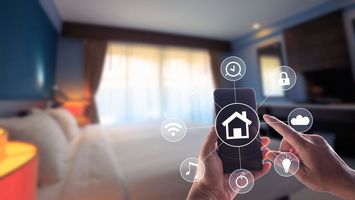
Today, in the developed countries of the world, many people have smart devices in their homes that work at our behest.
From Alexa to Siri and Google Home, smart light bulbs, security cameras, and home temperature thermostats are examples of this.
These are called the Internet of Things (IoT) in the language of technology. Even the appliances that we use in our kitchen have many types of sensors.
But in developing countries and backward countries of the world, such a smart device can only be imagined. Some people in these countries have such smart devices. In fact, such smart devices are more prevalent in developed countries.
It is being said that they are likely to be used more in the next ten years. But many people are frightened by the increasing use of these devices.
They call them spies. Apps, or devices that run from the Internet, run as we ordered. Whatever commands we give them are stored in them.
This information can be used in any form.
A research also says that the use of smart devices is promoting domestic violence and causing bitterness in relationships.
In particular, the use of smartphones is the most dangerous. This completely kills the privacy of any human being.
There are many such apps for smartphones, from which any person can be spied without his knowledge.
Many parents use them to keep an eye on their children. The cameras installed in our houses also keep an eye on the outsiders as well as the housemates.
Who came to the house, went to which room, how long has been there, you know everything even when you are away from home.
Even when you get out of the house, when you come inside the house, this information is also present in your camera, which can be used in any form.
If there are Internet-operated locks in the house, one can be locked in the house even when away from home.
The makers of smart devices may not have thought that they can be used to control and monitor each other's life.
But this is happening. We have seen an example of this in one case.
In Britain, a man named Ross Cairns spied his wife with a temperature-controlled microphone tablet in the house, which he was sentenced to 11 months in prison.
Many more such cases have also come up. Experts say that calling each other ill and assaulting them are old ways of bringing bitterness in relationships.
But the kind of crimes that are happening through smart devices are more dangerous.
When the control of all smart devices is in the hands of one person in the same house, the control is taken away from the other people living there.
He can use it as he wants.
The monitoring done by the device gradually leads to the chase. The altercation starts in the house.
To what extent will this dispute reach, it is difficult to say.
Around a third of women worldwide have experienced some form of physical or sexual abuse from their partner.
Such activities increase the risk of depression, miscarriage, low birth weight and HIV in children.
In some cases, the process of snooping goes on killing and stops. Stealing someone secretly is mental disturbing.
38 percent of women worldwide are murdered by their current or old partner.
Experts say that at the international level, domestic violence is more than we can imagine. It is like a virus that spreads from one another.
A 2017 study shows that children who see violence against women in their homes grow up do the same.
Domestic violence cases have increased a lot even during this time of lockdown.
Experts have also expressed concern that if the lockdown is extended for the next 6 months, there will be a terrible jump in domestic violence cases.
Many people do not even know how technology can be exploited.
For example, the room in which you are sleeping, suddenly raise the temperature there. Internet connected lock should lock you in the room.
Or let the bell door bell sound at midnight. The code of the door leading into the house should be changed without telling you.
All these actions are mind-boggling to you and come under the purview of domestic violence. But often women do not understand this closeness.
The cyber security expert says that 35 percent has been gained in the device that allows the exposure of your partner's message, the app that tracks the phone's location, or the device's camera to enter.
Interestingly, the one who is spied does not even know. And the app is put in his phone.
This is a gross violation of the right to privacy of someone and a great crime. But it is a pity that there are very few helplines to control such people.
In Britain, there is a helpline called Refugee, which monitors such people. But it has been observed that such helplines are also not very helpful.
She first advises the victim to change the password or device. And when this happens, the situation worsens further.
Even after ending the relationship with such spying partner, he does not get chased.
Actually people who do this type of espionage are a kind of patient. If a person suspects his partner, he can go to any extent.
Such people seek their happiness in the suffering of the front. Even after being away from his partner, he continues to harass him.
However, to control such people, there is talk of a change in the law. A number of organizations are also being formed to bring those who do such actions to their end.
Technology is to make our life easier. It should be used in the same way, not by making it a weapon, and to wring our own relationships.
Relationships are built on the foundation of trust. If you have to spy on your own partner then where is the trust?
If not trust, how is the relationship? It is better to be imprisoned in any bad relationship than it should be.