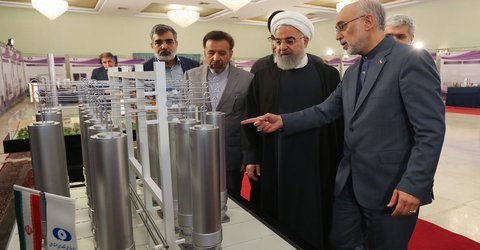
A new law has been passed in Iran's parliament that prohibits UN inspections at the country's nuclear facilities and at the same time Iran will now pursue uranium enrichment.
With the introduction of this new law, the government of Iran will be able to resume uranium enrichment by 20%, which was limited to 3.67% in the 2015 nuclear deal.
According to the 2015 agreement, Iran was allowed to limit its sensitive nuclear activities and allow international inspectors to arrive. In return, the economic sanctions imposed on Iran were ended.
However, Iran's President Hassan Rouhani said before the law was approved that he disagreed with the new law because it would harm diplomacy.
Iranian lawmakers have created this new law after the assassination of Iran's chief nuclear scientist Mohsin Fakhrizadeh on November 27, 2020.
Iran believes that Israel and an exiled opposition jointly attacked Fakhrizadeh with a remote-controlled weapon. Fakhrizadeh was considered the main actor of Iran's nuclear program.
The government of Iran has repeatedly emphasized that all its nuclear activities have been peaceful. Western countries prevented Iran from developing nuclear weapons through a stringent ban.
What does the new law of Iran say?
According to a new law passed by the Guardian Council of Iran, European countries such as Britain, France, Germany, which were included in the 2015 agreement, have been given two months' time to relax Iran's oil restrictions and economic sanctions.
These restrictions were imposed in 2018 after the Trump administration pulled out of the nuclear deal.
If work in this direction is not started within two months, the government of Iran will increase its uranium enrichment by 20% and build new technology-equipped centrifuge at its Nantz and Fordo nuclear center where uranium will be grown.
Under this law, the United Nations will not be able to inspect Iran's nuclear facilities.
According to Iranian news agency Fars, on 02 December 2020, through a letter, the spokesperson of the Parliament of Iran has formally appealed to President Rouhani to implement this new law.
Even before this law was approved, Iran's President Hassan Rouhani said that his government does not agree with this new law. He called this law "harmful for diplomacy" of the country.
Donald Trump and Joe Biden differ on nuclear deal
The nuclear deal was canceled by US President Donald Trump in 2018. He said he wanted a new agreement with Iran that would put an indefinite moratorium on its nuclear program and the development of ballistic missiles. In return, the US imposed strong sanctions on Iran.
On the other hand, the newly elected US President Joe Biden has said that he will re-implement the nuclear deal during the Obama government and if Iran 'strictly abides by the nuclear deal', then the sanctions imposed on Iran will be lifted.
Biden will take oath of President of the United States on January 20, 2021.
In July 2019 itself, Iran raised the limit of 3.67 percent enriched uranium to 4.5% for making nuclear weapons.
U-235 isotopes of low-enriched three to five percent density uranium can be made using electricity as fuel.
The uranium used to make weapons is 90 percent or more enriched.
The 2015 nuclear deal was done to halt Iran's nuclear program and ended sanctions on Iran instead. The United States, Britain, Russia, Germany, France and China had also signed on this nuclear deal with Iran.
Iran believes that Israel and an exiled opposition group used a remote controlled weapon to kill its top nuclear scientist Mohsin Fakhrizadeh on 27 November 2020.
During Fakhrizadeh's funeral in Tehran, Iran's security chief Ali Shamkhani said the attackers used electronic equipment and were not present at the scene of the incident.
However, he did not give further information about it. The Iranian Defense Ministry initially said that Fakhrizadeh's car was targeted by some gunmen and he was shot at the same time.
Israel has not yet commented on these Iranian claims. Fakhrizadeh played a key role in Iran's nuclear program in the early 2000s.
The most important thing is that recently Israel had told Fakhrizadeh that he is engaged in developing Iran's secret nuclear weapon.
Iran has always been saying that its nuclear program is not for developing weapons. Fakhrizadeh's funeral was held on the campus of Iran's Ministry of Defense in Tehran. Some remains of funerals were handed over to a cemetery in northern Tehran.
Iran's official TV showed that soldiers and senior officers were moving the Fakhrizadeh's coffin wrapped in the Iranian national flag. These included intelligence minister Mahmood Alawi, Revolutionary Corps Commander General Hussein Salami and Atomic Program Head Ali Akbar Salehi offering prayers in Fakhrizadeh's tribute.
Iran's Supreme National Security Council Secretary Admiral Shamkhani said at Fakhrizadeh's funeral program that Iranian intelligence and security services had foreseen the plot of Fakhrizadeh's assassination.
Shamkhani said, "Necessary measures were taken to protect them, but the enemies used a whole new way. This murder has been carried out in a professional and special manner. Unfortunately our enemies were successful in this. It was a very complex mission because it uses electronic equipment. No one was present at the scene of the incident.
Admiral Shamkhani said that some clues have been found of the perpetrators of this murder. He said, "It has definitely been involved with the Jewish regime and the Mossad-led Iranian opposition group Mujahideen-e-Khalq (MKO)."
Mossad is the intelligence agency of Israel and has been used for Jewish rule of Israel. The MKO is an outcast opposition faction of Iran that opposes the structure of the current government in the country. The statement came from Iran when the Fars news agency reported the use of remote-controlled machine guns in the killing of Fakhrizadeh.
According to Arabic-language Al-Alam TV report, such a weapon is used through satellite control. On 27 November 2020, when the Iranian nuclear scientist was killed, the Defense Ministry said that in East Tehran, armed militants attacked Fakhrizadeh's car.
The ministry had said that Fakhrizadeh was shot in the crossfire between his security guards and the attackers and died during this time. Photos posted on social media show debris and blood strewn with a car riddled with bullets.
At Fakhrizadeh's funeral on 30 November 2020, Iran's Defense Minister General Aamir Hatami reiterated the resolution that the assassination would be avenged.
Aamir said, "The enemies know and as a soldier I am telling them that the people of Iran will answer everyone."
The Iranian Defense Minister said that Fakhrizadeh was doing important work in the Organization of Defense Innovation and Research. Iran is working here for nuclear security.
In Persian this organization is called SPND. The Iranian Defense Minister said that SPND's budget will be doubled so that the path of 'martyr doctor' can be achieved more quickly.
Iran's media emphasizes two things. The first is to avenge the assassination of the Iranian scientist, and the second is that Iran should not be deceived by Israel because it wants to increase tensions and ruin Iran's nuclear program.
India has rejected the proposal passed in the meeting of foreign ministers of member countries of the Organization of Islamic Cooperation (OIC), an organization of Islamic countries. Kashmir has also been mentioned in this proposal.
The Indian Ministry of External Affairs stated that India's reference in the resolution passed in the OIC is factually incorrect, unreasonable and inappropriate.
There was a meeting of the Council of Foreign Ministers (CFM) of the OIC on 27 and 28 November 2020 in Niamey, the capital of Niger, and Kashmir is also mentioned in the resolution passed in this meeting.
Pakistan is also a member of the OIC. Pakistan Foreign Minister Shah Mehmood Qureshi attended the meeting and raised the issue of Kashmir loudly.
Pakistan is happy with the mention of Kashmir in the resolution passed in the meeting of the Foreign Ministers of the OIC. This proposal is being called Niamey Declaration and Pakistan has welcomed it.
India ended Kashmir's special status on August 5, 2019. Since then Pakistan has been raising this issue on the international stage but so far there has been no concrete success. OIC has also not been very active about this till now.
Regarding the proposal passed in the CFM of OIC, India's Foreign Ministry has said in its statement, "We are factually incorrect, inappropriate and unreasonably passed in the OIC's 47th CFM in Niger's capital Niamey, India. Let's dismiss the mention of We have always said that the OIC has no right to speak on India's internal affairs. Jammu and Kashmir is also an integral part of India and the OIC has no right to speak on it.''
India has said in its statement, "It is regrettable that the OIC is allowing any one country to misuse its platform." The country that the OIC is allowing to do so has a disgusting record of religious tolerance, extremism and injustice with minorities. That country is always engaged in anti-India propaganda. We are seriously advising the OIC to refrain from saying such a thing about India in future.''
Kashmir has also been included in the resolution passed at the meeting of foreign ministers of the OIC member countries in Niamey.
However, Kashmir was not included in the OIC's CFM agenda. It is being said that due to the stubbornness of Pakistan, it has been included only. The resolution said that the OIC's stand on the Kashmir dispute has always been that it should be resolved peacefully as per the UN Security Council resolution.
However, it is also being said that the mention of Kashmir in the proposal of OIC is a ritual and it is not surprising for India. Despite the pressure from Pakistan, Kashmir was not included as a separate agenda in this meeting.
The OIC is dominated by Saudi Arabia and the UAE. Pakistan's relations with these two countries are deteriorating. Saudi Arabia wants Pakistan to pay its debts quickly. Especially since when Pakistani PM Imran Khan tried to create an organization with Turkey, Iran and Malaysia parallel to the OIC. Last week, the UAE temporarily banned the issuance of new visas for Pakistani nationals.
Pakistan Foreign Minister Shah Mehmood Qureshi also raised the issue separately in the OIC meeting with the UAE Foreign Minister but no concrete assurance has been received so far.
Is Kashmir a victory in the Niamey Declaration?
This meeting was held in Abu Dhabi in March 2019. In this meeting, the then Foreign Minister of India Sushma Swaraj was also called by the UAE.
Pakistan had opposed the calling of Sushma Swaraj and boycotted the inauguration ceremony. Sushma Swaraj then addressed the CFM meeting of the OIC.
There was no mention of Kashmir in the resolution passed in this meeting. It welcomed the decision of Pakistani Prime Minister Imran Khan in which he sent back Wing Commander Abhinandan of India.
Kashmir is nothing new in the proposal that comes after the meeting of the Foreign Ministers of OIC. It has been mentioned before also. This time the proposal is being called Niame Declaration. Its operative paragraph eight states that the OIC wants the resolution of the Jammu and Kashmir dispute to be peaceful as per the UN Security Council resolution and it has always been the same.
This was the first meeting of the Foreign Ministers of the OIC after the end of special status of Jammu and Kashmir on 5 August 2019. Pakistan hoped that this time a strong statement would be issued against India, but this did not happen.
Pakistan's Ambassador to India Abdul Basit has posted a video on Twitter and he has said many things about Niamey Declaration.
Basit has said, "This was the first meeting of the Foreign Ministers of the OIC after August 5 and we were hopeful that some strong statement about India would be issued." We felt that India's decision would be condemned but it did not happen. There is nothing very happy for Pakistan in the Declaration.
He said, "The way Kashmir is concerned about Palestine, Azerbaijan and terrorism in this Declaration does not belong to Kashmir. Compared to last year, we can be happy that this time, at least it has been mentioned. India should have condemned what it did on August 5, but it did not happen. Niger has good relations with India and the convention center in which this conference took place is made with the help of India only.
The Maldives is also a member of the OIC. Maldives Foreign Minister Abdullah Shahid attended the meeting. Abdullah posted a tweet on November 27, 2020 in which pictures of that conference center in Niamey were posted. With these pictures, Abdullah wrote in his tweet, "OIC's 47th CFM meeting is being held at the beautiful Mahatma Gandhi International Conference Center in Niamey. When the world is facing many challenges and crises, these can be faced together. ''
However, Pakistan is considering its victory with the mention of Kashmir. Pakistan's Foreign Ministry has tweeted, "The inclusion of the Jammu and Kashmir dispute in the Niamey Declaration suggests that the OIC has always stood by the Kashmir issue."
Ever since India abolished the special status of Kashmir, Pakistan has been calling for a meeting of the foreign ministers of the OIC member countries but to no avail.
In August 2020, Pakistan Foreign Minister Shah Mehmood Qureshi had threatened to withdraw from the OIC and raise the Kashmir issue. This angered Saudi Arabia and Pakistan had to issue an explanation. But by then the situation had deteriorated and Pakistan Army Chief General Qamar Javed Bajwa had to visit Saudi to handle it.
Iran's President Hassan Rouhani has said that the killing of the country's senior nuclear scientist will not slow down the country's nuclear program.
Hasan Rouhani accused Israel of killing top nuclear scientist Mohsin Fakhrizadeh and said that these steps show how upset he is and how much he hates us.
Iran had earlier appealed to the UN Secretary-General and the Security Council to condemn the killing of its top nuclear scientist Mohsin Fakhrizadeh.
According to the information received so far, Fakhrizadeh was ambushed by gunmen in the city of Absard, adjacent to the capital Tehran. However, no news of any attacker has been caught so far.
Ambassador to the United Nations of Iran Majid Takht Ravanchi said the killing of Mohsin Fakhrizadeh was a clear violation of international laws, which was carried out with the aim of creating unrest in the region.
At the same time, UN Secretary-General Antonio Guterres has appealed for restraint in this matter.
According to Reuters, Guterres spokesman Farhan Haq said on 27 November 2020, "We have noted the news of the killing of an Iranian nuclear scientist near Tehran today. We urge restraint and avoid any action which may increase tension in the area. ''
Other Iranian authorities have accused Israel of murder and warned of revenge.
Israel has not yet responded to this, but has previously accused Mohsin Fakhrizadeh of being the mastermind of a secret nuclear weapons program.
What is the whole matter?
Iran's Ministry of Defense informed that one of its top nuclear scientist Mohsin Fakhrizadeh has been killed. After the attack Fakhrizadeh was taken to a local hospital but his life could not be saved.
Iran's Foreign Minister Mohammad Jawad Zarif condemned Fakhrizadeh's murder, calling it 'a state-sponsored terror incident'.
Intelligence agencies of Western countries believe that Mohsin Fakhrizadeh was behind Iran's intelligence program.
Foreign diplomats called him 'the father of the Iranian atomic bomb'. Iran has been saying that its nuclear program is for peaceful purposes.
Four nuclear scientists from Iran were killed between 2010 and 2012, and Iran blamed Israel for this.
How was Mohsin Fakhrizadeh murdered?
Iran's Defense Ministry issued a statement on 27 November 2020 saying, "Armed militants targeted the car carrying Mohsin Fakhrizadeh, the head of the Ministry of Defense's research and innovation department."
According to the ministry, "He was badly injured in the skirmish between the militants and Fakhrizadeh's bodyguards and was taken to a local hospital but unfortunately all attempts by the medical team to save him failed."
According to Iranian news agency Fars, the eyewitnesses first heard the sound of explosions and then firing from machine guns.
According to the agency, eyewitnesses have also said that three-four extremists were killed.
Is Israel involved in this murder?
Iran's Foreign Minister Jawad Zarif tweeted, "Terrorists have killed a prominent Iranian scientist today. These rude actions, which have serious indications of Israel being at hand, reflect the assassins' intention to fight. ''
Zarif said, "Iran urges international communities, especially the European Union, to end their shameful double stance and condemn this terrorist move."
He said in another tweet, "Iran is once again a victim of terrorism. Terrorists have brutally murdered a great Iranian scholar. Our heroes have always faced terrorism for stability and security in the world and our region. The punishment of those who do wrong is the law of Allah.
The Islamic Revolutionary Guard Corps (IRGC) of the Iranian Army has said that Iran will avenge the killing of its scientist.
Major General Hussein Salami of the Islamic Revolutionary Guard Corps said, "There is a clear attempt to stop us from accessing modern science by killing nuclear scientists."
Who was Mohsin Fakhrizadeh?
Mohsin Fakhrizadeh was Iran's foremost nuclear scientist and a senior IRGC official. According to security experts from Western countries, he was very powerful in Iran and had a major role in Iran's nuclear weapons program.
Israel claimed to have obtained some intelligence documents in the year 2018, according to which Mohsin started Iran's nuclear weapons program.
At the time, Netanyahu gave Mohsin Fakhrizadeh a key scientific agreement for Iran's nuclear program in a press conference, saying, "Remember that name."
In 2015, the New York Times compared Mohsin Fakhrizadeh to J. Robert Openheimer. Openheimer was the scientist who led the Manhattan Project that produced the first atomic bomb during World War II.
Israel has not yet reacted to Fakhrizadeh's assassination.
Why was Mohsin Fakhrizadeh targeted?
Mohsin Fakhrizadeh was certainly an important figure as head of the Department of Research and Innovation in the Iranian Ministry of Defense. This is the reason why Israeli Prime Minister Binyamin Netanyahu said in a warning tone two years ago, 'Remember his name'.
Since the US split from the 2015 Iran nuclear deal, Iran has moved forward. Iran has accumulated reserves of low enrichment uranium and has cultivated uranium higher than the level set in the agreement.
Iranian officials have been saying from the beginning that enriched uranium can be destroyed, but it is very difficult to eradicate the work done towards research and development.
Ali Asghar Sutlaniya, former Ambassador of Iran to the International Atomic Energy Agency (IAEA), recently said, "We cannot go back."
If Mohsin Fakhrizadeh was really as important to Iran's nuclear program as Israel is alleged to have been in his accusations, his assassination probably suggests that someone is trying to rein in Iran's momentum.
America's newly elected President Joe Biden said that he would return to the Iran nuclear deal after coming to power. The murder of Mohsin Fakhrizadeh could also be an attempt to make any such possibility difficult.
Russia has said that it will destroy the American ship entering its seabed.
He says that his warship followed a US Navy destroyer that entered its territory in the Japan Sea.
The destroyer of the US Navy is named USS John S. Machen.
The USS John S. Machen was within two kilometers of Peter the Great Gulf on its maritime boundary.
Russia says that it had warned to destroy this ship, after which the ship departed from its territory.
However, the US Navy has denied any wrongdoing and also said that its ship was not asked to go anywhere.
The incident occurred on 24 November 2020 in the Japan Sea. This region is also known as East Sea.
Russia's Ministry of Defense said its Pacific fleet destroyer Admiral Vinogradov warned the US ship via the International Communication Channel.
It was said in the threat that "power can be used to drive out the intruder coming into its sea area".
However, Lieutenant Joey Kelly, spokesman for the US Navy's Seventh Fleet, responded to the claim that "Russia is committing misrepresentation." The USS John S. Machen was not asked by any country to leave his territory.
He said, "The United States will never accept the illegal claims made on the maritime boundaries, as Russia did in this case."
Such incidents occur only occasionally in the sea. However, Admiral Vinogradov was almost caught by an American ship in the East China Sea.
At that time also, Russia and the US had accused each other of counter-allegations.
The situation of conflict between the two countries in the sea and in the air sector is maintained from time to time.
In 1988, the then Soviet Union warship Bezzavanti hit the American ship Yorktown in the Black Sea.
Even then the Soviet Union accused the American ship of infiltrating its maritime boundary. Relations between Russia and the United States have gone through ups and downs.
Russian President Vladimir Putin has not yet wished the newly elected President of the United States, Joe Biden, for his victory.
The final agreement on the nuclear weapons issue between the two countries is yet to be finalized. Its deadline is till February.
The two countries signed the New Start Treaty in 2010, under which both countries decided that they would reduce the number of nuclear weapons capable of long-range kill to a certain extent.
In 2017, the USS John S. Machen had an encounter near Singapore in which ten sailors were killed.
Pakistan Prime Minister Imran Khan completed his first visit to Afghanistan on 19 November 2020 where he met Afghan President Ashraf Ghani and agreed to intensify efforts to increase the transfer of intelligence and closer cooperation.
According to Pakistan's official news service Radio Pakistan, Imran Khan and Ashraf Ghani reiterated their commitment to take immediate steps to establish peace in Afghanistan at a press conference in Kabul.
On Pakistan Prime Minister Imran Khan's visit to neighboring Afghanistan, analysts say that it will take time to restore trust and end differences between the two countries but it is necessary for improving relations between the two countries.
According to an official statement, Prime Minister Imran Khan, who visited Kabul for the first time in Afghanistan, spoke of bilateral relations, global peace and regional development.
On this, many commentators of Pakistan say that Pakistan has done much to establish peace in Afghanistan on its own behalf and now Afghanistan should do the same.
Analyst Imtiaz Gul says the peace agreement was signed after successful efforts in Doha between the US and the Taliban due to Pakistan's efforts.
He said that the recent visit to Afghanistan from Prime Minister Imran Khan is a link in this regard.
He said that Pakistan has agreed to end violence in Afghanistan from day one and Prime Minister Imran Khan's visit to Afghanistan has also sent a message to the Taliban to leave the path of violence.
Imtiaz Gul says that lack of trust cannot be eliminated or reduced in a single stroke, but both sides need to take steps to restore mutual trust.
He said that Pakistan has allowed thousands of stranded containers on the Pak-Afghan border to move forward in the last few days. The Pakistani government has also introduced a six-month multiple visa for Afghan nationals.
Seven rounds of negotiations have also been held for a trade agreement between the two countries.
Imtiaz Gul says, "Afghanistan has more inclination towards India, so all countries should play their part for a stable peace in the region."
On 19 November 2020, Prime Minister Imran Khan has said that we will help fulfill the expectations of the Government of Afghanistan to build trust.
On the other hand, Afghan President Ashraf Ghani, while welcoming the visit of Imran Khan, has given it an important agreement to increase trust and cooperation.
Senior journalist Rahimullah Yusufzai says that there are differences in many matters between the two countries and relations will not improve until they end.
He said, "The latest statement from the Government of Pakistan has been that Afghanistan's land is being used for incidents of violence in Pakistan, but the Afghan government has denied these statements."
Even before this, Pakistan has been accusing India of using Afghanistan's land for violence incidents in Pakistan.
The Afghan government has also been told to stop India from using its land. However, both India and Afghanistan continue to deny the allegations.
Rahimullah Yusufzai says that Afghanistan has not accepted the border with Pakistan till date.
He says, "Afghan President Ashraf Ghani and Chief Executive Abdullah Abdullah also visited Pakistan, but despite this the two countries have not been able to trust each other."
He said that both countries must speed up their efforts to eradicate stable peace and violence in the region.
The US will withdraw two thousand troops from Afghanistan by February 2021, and in such circumstances, closer cooperation between the two neighboring countries is necessary for the sake of peace.
Rahimullah Yusufzai says that Pakistan will benefit more by increasing trade between the two countries. The more the business between the two countries increases, the more the common citizens will benefit.
He said that trade between the two countries could reduce food prices, which would give some relief to the people.
Yusufzai says, "Afghanistan wants to do business with India through the Wagah border, but Pakistan is not ready to do so.''
On 15 November 2020, 15 countries in the Asia-Pacific Ocean region, including China, signed the world's largest trade treaty in Hanoi, Vietnam.
Countries that have joined this trade treaty account for about one-third of the global economy.
The Regional Comprehensive Economic Partnership, or RCEP, has ten countries in Southeast Asia. Apart from these, South Korea, China, Japan, Australia and New Zealand have also joined it.
The US is not involved in this trade-treaty and China is leading it, so most economic analysts see it as a growing influence of China in the region.
This treaty is being said to be bigger than the European Union and the US-Mexico-Canada trade agreement.
Previously, the US was also involved in a trade treaty called the Trans-Pacific Partnership (TPP), but in 2017, shortly after becoming president, Donald Trump had moved the US out of the treaty.
The deal then included 12 countries in the region that also had the support of former US President Barack Obama as they viewed the trade treaty as a response to Chinese-domination.
The negotiations on the RCEP were also underway for the last eight years, which were finally signed on 15 November 2020.
The countries involved in this treaty believe that this will help in improving the situation like the Great Depression caused by the corona virus epidemic.
On this occasion, Vietnam's Prime Minister Nun-Xuan-Fook, describing it as the foundation of the future, said, "Today the RCEP agreement was signed, it is a matter of pride, it is a big step that ASEAN countries are playing a central role in it, And together with the fellow countries, they have established a new relationship that will become stronger in the future. As these countries move towards progress, so will its effect on all countries of the region. ''
According to this new trade treaty, RCEP will abolish customs duties on a variety of goods within the next twenty years. This would include intellectual property, telecommunications, financial services, e-commerce and business services. However, regulations like which country a product originated in may have some effect but in countries that are part of the treaty, there is already agreement on free-trade among many countries.
With this trade treaty, China's influence in the region has deepened.
India not included in RCEP
India is not a part of this treaty. India was also involved in the RCEP at the time of bargaining, but India was separated from it last year. The Government of India had then said that this would lead to a flood of cheap Chinese goods in the country and it would be difficult for small scale manufacturing traders in India to deliver goods at a price that would increase their troubles.
But on 15 November 2020, ASEAN countries who joined the treaty said that 'the gates will remain open for India, if in future India can join RCEP'.
The question arises that what can be the effect on India not being part of this trade group? To understand this, BBC correspondent Faisal Mohammed Ali spoke to India-China business affairs expert Santosh Pai.
He said, "RCEP has a membership of 15 countries. About 30 percent of the world's construction industry is from these countries. In such a situation, such free-trade agreements are very important for India, because India can explore many new possibilities of trade through them. ''
"Like India is inviting many countries to come and invest in the construction industry, so they also attract such agreements, but if India is not in it, then it becomes a question that they should come to India How to get promoted? "
"The second thing is that the buying capacity of consumers in India is increasing, but compared to the international level, it is still very low. If a foreign company has to come and manufacture in India, then also to export it Much care has to be taken because it is consumed in the domestic market of India, it seems a bit difficult. "
At one time India, along with countries like Japan and Australia, wanted to reduce dependence on China. But now those countries are involved in it and India is different from it. What is the reason for this?
To this Santosh Pai said, "How much India can reduce 'dependence on China', it will not be seen in six-seven months, but in five years, it will show its full effect. Only then will know how much India has Seriously it did. The rest of the countries have been trying to reduce their dependence on China for many years, and that is why these countries do not want to stay out of the RCEP because they know that by staying inside it 'Can better reduce dependence on China'. "
He said, "Apart from China, there are many strong countries in RCEP which have excellent work in many fields (like electronics and automobiles). But India's problem is that till last year, India was trying a lot to increase sugar trade more and more. How to increase more and attract Chinese investment more and more?''
India had a target of $ 100 billion in terms of trade with China. But in the last six months, the situation has changed completely due to political reasons. Now the Indian government has started a self-reliance campaign which aims to reduce trade with China and limit Chinese investment as well.
In the end, Pai said, "Even if the 'self-reliance campaign' was taken seriously, it would take years to get its effect. So it would be too early to say anything now.''

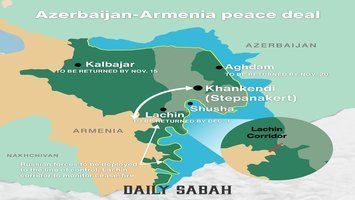
Armenia, Azerbaijan and Russia have signed an agreement to end the military conflict on the disputed part of Nagorno-Karabakh late on 9 November 2020.
Armenian Prime Minister Nicole Pashinyan described the deal as 'painful for himself and his countrymen'.
After six weeks of this ongoing war between Azerbaijan and ethnic Armenians, this agreement has now been reached.
Nagorno-Karabakh is part of Azerbaijan internationally but since 1994 Nagorno-Karabakh has been occupied by Armenia and ethnic Armenians living there.
In 1994, the ceasefire agreement was reached, rather than a peace agreement between the two countries.
Several ceasefire agreements were reached after the war resumed on 27 September 2020, but all of them have failed.
What is in this agreement?
Under this late-night agreement on 9 November 2020, Azerbaijan will retain the territories of Nagorno-Karabakh that it has occupied during the conflict.
In the next few weeks, Armenia has also agreed to retreat from many nearby areas.
In a televised address, Russian President Vladimir Putin has said that 1960 Russian peacekeepers have been sent to the area.
Azerbaijan President Ilham Aliyev has said that Turkey will also participate in the process of establishing this peace.
In addition, according to the agreement, the prisoners of war will also be assigned to each other.
President Aliyev said that this agreement has historical significance. On which Armenia has agreed but is unwilling.
At the same time, Armenia's Prime Minister Pashinyan has said that this agreement has been taken in view of the situation after talking to the experts of this area and after thorough analysis.
He said, it is not a victory but it is not a defeat until you consider yourself a loser.
A large number of people have gathered in Yerevan, the capital of Armenia, and are opposing the deal.
PubG Corporation, the company that created the popular mobile game 'PUBG', has decided to suspend the franchise of Chinese company Tencent Games in India, after which there is a possibility that this mobile game will once again return to the mobile of Indian users.
As reported by the Business Standard newspaper, the South Korean company PubG Corporation wrote in a blog on Tuesday that "we respect the decision taken by the Indian government, keeping in mind the security and privacy of the players' data."
"It is also important for the company that the players' data is completely protected. For this, the company is taking all the responsibility related to this game. Also, in the near future, the company will work on providing better gaming experience to Indian players.
According to the newspaper's report, after this decision, the legal right to operate the PUBG game in India will no longer be with the Chinese company Tencent Games, which has the global franchise of the mobile version of the game.
Now South Korea company PUBG Corporation, which produces this app, will be the publisher company of PUBG Mobile in India.
Last week, the Indian government banned 118 Chinese mobile apps including PUBG, citing data security and privacy as the basis.
The newspaper wrote in its report that the Chinese company Tencent owns about 10% stake in a company called Bluehole Studio and Bluehole Studio is the parent company of PubG Corporation, located in Seoul City, South Korea.
According to the company, more than 600 million people worldwide have downloaded PUBG and over 50 million people are its active players. India is an important market for the company as around 33 million people have been playing this game in India.
According to the newspaper report, after this change, the argument of South Korean company PUBG Corporation has been strengthened that 'this game is no longer related to the Chinese company', but experts are of the opinion that even after this decision, PUBG's path It will not be completely easy as PUBG Corporation will have to first satisfy the Government of India what will be the difference with their decision related to Tencent Games.
China has responded sternly to the Indian Minister of State Kiren Rijiju's question about the alleged kidnapping of five Indians by the Chinese military from the border in Arunachal Pradesh, India. China has said that it does not consider Arunachal Pradesh as a part of India, rather it is a region of China's southern Tibet.
According to China's official newspaper Global Times, China's foreign ministry spokesman Chao Lijiang said, "China has never recognized the 'alleged' Arunachal Pradesh, it is the territory of southern Tibet of China." We have got a question from the Indian Army about the five missing Indians from this area, but we do not have any information about it at this time. ''
The Indian Army raised the issue of alleged abduction of five people by the People's Liberation Army (PLA) soldiers from Upper Subansiri district in Arunachal Pradesh to the Chinese Army.
Giving information about this, Union Minister Kiren Rijiju wrote on Sunday night through a tweet that the Indian Army is waiting for China's reply. He wrote, "The Indian Army has sent a message to the People's Liberation Army counterpart, waiting for a reply."
Actually, Rijiju wrote this in response to a tweet from a journalist. A journalist asked via tweet, "What is the update on the alleged kidnapping of five Indians from Arunachal Pradesh by the People's Liberation Army?" Will the Ministry of External Affairs, Kiren Rijiju, Prema Khandu share any updates on this? ''
In June this year, 20 Indian soldiers died in a clash between India and China on the Ladakh border and since then tensions between the two countries have been increasing.
A retired general of the Indian Army, speaking to the BBC on condition of anonymity, said, "China's attitude towards Arunachal Pradesh is not new at all." Even before this, China has considered Arunachal Pradesh as its share. China has already made it clear that it does not follow the McMahon Line. This is the reason why China has always been negative when the Tibetan religion Guru Dalai Lama became a refugee in India.
"Generally, India used to keep base camps about 70-80 km behind the Sino-India border but from 1986-87, the Indian Army moved in its own part by reducing the distance from the border. Although China did not object at that time because the growth rate of India-China was almost the same at that time, but in 2008 when India came close to the US and the nuclear treaty was reached between the two countries, China sure got knocked. Now, in recent times, construction work in the border areas from India has increased and that is why China is creating tension on the border. ''
The clash also took place on the night of 29 August
Earlier on the night of 29-30 August, according to the Indian Army, there was a skirmish between the soldiers of both the countries. So far no information has been received about anyone's injuries. The Indian Army had issued a statement saying that the Chinese People's Liberation Army (PLA) tried to change the status quo on the border, but the vigilant Indian soldiers did not allow this to happen.
According to this statement, "Indian troops have stopped the provocation of Chinese troops in Pangong Tso Lake." The Indian Army is in favor of restoring peace through dialogue but at the same time is committed to safeguarding the integrity of its territory. The whole dispute continues at the brigade commander level.
However, China denied reports of its troops crossing the LAC.
China's Foreign Ministry stated that China's military strictly follows the Line of Actual Control and that China's military has never crossed this line. The military of the two countries are in touch on this issue.
On the other hand, Chinese Foreign Minister Wang Yi has said, "China is committed to maintaining stability along the India-China border." China will never take the initiative to make the situation tense or provoke. ''
Giving a speech at the French Institute of International Relations, he said, "The border between the two countries is not yet fixed, so there are problems." China will maintain its sovereignty and territorial integrity firmly, and is ready to resolve all kinds of issues through dialogue with the Indian side. ''
He also said that China believes in the policy of 'Good Neighborhood', and wants friendly and stable relations with its neighbors.
India and China have a 3,500-km-long border and the two countries do not agree on the current state of the border. There has also been a war in 1962 in this country.