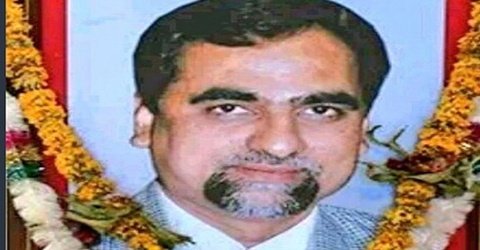
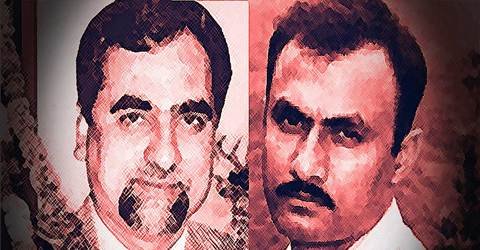
Brijgopal Harkishan Loya, the judge presiding over the CBI special court in Mumbai, died sometime between the night of 30 November and the early morning of 1 December 2014, while on a trip to Nagpur. At the time of his death, he was hearing the Sohrabuddin case, in which the prime accused was the Bharatiya Janata Party president Amit Shah. The media reported at the time that Loya had died of a heart attack. But my investigations between November 2016 and November 2017 raised disturbing questions about the circumstances surrounding Loya’s death—including questions regarding the condition of his body when it was handed over to his family.
Among those I spoke to was one of Loya’s sisters, Anuradha Biyani, a medical doctor based in Dhule, Maharashtra. Biyani made an explosive claim to me: Loya, she said, confided to her that Mohit Shah, then the chief justice of the Bombay High Court, had offered him a bribe of Rs 100 crore in return for a favourable judgment. She said Loya had told her this some weeks before he died, when the family gathered for Diwali at their ancestral home in Gategaon. Loya’s father Harkishan also told me that his son had told him he had offers to deliver a favourable judgment in exchange for money and a house in Mumbai.
Brijgopal Harkishan Loya was appointed to the special CBI court in June 2014, after his predecessor, JT Utpat, was transferred within weeks of reprimanding Amit Shah for seeking an exemption from appearing in court. According to a February 2015 reportin Outlook, “During the CBI court’s hearings that Utpat presided over for this one year, or even after, court records suggest Amit Shah had never turned up even once—including on the final day of discharge. Shah’s counsel apparently made oral submissions for exempting him from personal appearance on grounds ranging from him being ‘a diabetic and hence unable to move’ to the more blase: ‘he is busy in Delhi.’”
The Outlook report continued: “On June 6, 2014, Utpat had made his displeasure known to Shah’s counsel and, while allowing exemption for that day, ordered Shah’s presence on June 20. But he didn’t show up again. According to media reports, Utpat told Shah’s counsel, ‘Every time you are seeking exemption without giving any reason.’” Utpat, the story noted, “fixed the next hearing for June 26. But on 25th, he was transferred to Pune.” This was in violation of a September 2012 Supreme Court order, that the Sohrabuddin trial “should be conducted from beginning to end by the same officer.”
Loya had at first appeared well disposed towards Shah’s request that he be exempted from personally appearing in court. As Outlook noted, “Utpat’s successor Loya was indulgent, waiving Shah’s personal appearance on each date.” But this apparent indulgence may just have been a matter of procedure. According to the Outlook story, “significantly, one of his last notings stated that Shah was being exempted from personal appearance ‘till the framing of charges.’ Loya had clearly not harboured the thought of dropping charges against Shah even when he appeared to be gentle on him.” According to the lawyer Mihir Desai, who represented Sohrabuddin’s brother Rubabuddin—the complainant in the case—Loya was keen on scrutinising the entire chargesheet, which ran to more than 10,000 pages, and on examining the evidence and witnesses carefully. “The case was sensitive and important, and it was going to create and decide the reputation of Mr Loya as a judge,” Desai said. “But the pressure was certainly mounting.”
Nupur Balaprasad Biyani, a niece of Loya’s who stayed with his family in Mumbai while studying in the city, told me about the extent of the pressure she witnessed her uncle facing. “When he was coming from the court, he was like, ‘bahut tension hai,’” she said. “Stress. It’s a very big case. How to deal with it. Everyone is involved with it.” Nupur said it was a question of “political values.”
Desai told me, “The courtroom always used to be extremely tense. The defence lawyers used to insist on discharging Amit Shah of all the charges, while we were demanding for the transcripts of the calls, submitted as evidence by the CBI, to be provided in English.” He pointed out that neither Loya nor the complainant understood Gujarati, the language on the tapes.
But the defence lawyers, Desai said, repeatedly brushed aside the demands for transcripts in English, and insisted that Shah’s discharge petition be heard. Desai added that his junior lawyers often noticed unknown, suspicious-looking people inside the courtroom, whispering and staring at the complainant’s lawyers in an intimidating manner.
Desai recounted that during a hearing on 31 October, Loya asked why Shah was absent. His lawyers pointed out that he had been exempted from appearance by Loya himself. Loya remarked that the exemption applied only when Shah was not in the state. That day, he said, Shah was in Mumbai to attend the swearing-in of the new BJP-led government in Maharashtra, and was only 1.5 kilometres away from the court. He instructed Shah’s counsel to ensure his appearance when he was in the state, and set the next hearing for 15 December.
Anuradha Biyani told me that Loya confided in her that Mohit Shah, who served as the chief justice of the Bombay High Court between June 2010 and September 2015, offered Loya a bribe of Rs 100 crore for a favourable judgment. According to her, Mohit Shah “would call him late at night to meet in civil dress and pressure him to issue the judgment as soon as possible and to ensure that it is a positive judgment.” According to Biyani, “My brother was offered a bribe of 100 crore in return for a favourable judgment. Mohit Shah, the chief justice, made the offer himself.”
She added that Mohit Shah told her brother that if “the judgment is delivered before 30 December, it won’t be under focus at all because at the same time, there was going to be another explosive story which would ensure that people would not take notice of this.”
Loya’s father Harkishan also told me that his son had confided in him about bribe offers. “Yes, he was offered money,” Harkishan said. “Do you want a house in Mumbai, how much land do you want, how much money do you want, he used to tell us this. This was an offer.” But, he added, his son refused to succumb to the offers. “He told me I am going to turn in my resignation or get a transfer,” Harkishan said. “I will move to my village and do farming.”
I contacted Mohit Shah and Amit Shah for their responses to the family’s claims. At the time this story was published, they had not responded. The story will be updated if and when they reply.
After Loya’s death, MB Gosavi was appointed to the Sohrabuddin case. Gosavi began hearing the case on 15 December 2014. “He heard the defence lawyers argue for three days to discharge Amit Shah of all the charges, while the CBI, the prosecuting agency, argued for 15 minutes,” Mihir Desai said. “He concluded the hearing on 17 December and reserved his order.”
On 30 December, around one month after Loya’s death, Gosavi upheld the defence’s argument that the CBI had political motives for implicating the accused. With that, he discharged Amit Shah.
The same day, news of MS Dhoni’s retirement from test cricket dominated television screens across the country. As Biyani recounted, “There was just a ticker at the bottom which said, ‘Amit Shah not guilty. Amit Shah not guilty.’”
Mohit Shah visited the grieving family only around two and half months after Loya’s death. From Loya’s family, I obtained a copy of a letter that they said Anuj, Loya’s son, wrote to his family on the day of the then chief justice’s visit. It is dated 18 February 2015—80 days after Loya’s death. Anuj wrote, “I fear that these politicians can harm any person from my family and I am also not powerful enough to fight with them.” He also wrote, referring to Mohit Shah, “I asked him to set up an enquiry commission for dad’s death. I fear that to stop us from doing anything against them, they can harm anyone of our family members. There is threat to our lives.”
Anuj wrote twice in the letter that “if anything happens to me or my family, chief justice Mohit Shah and others involved in the conspiracy will be responsible.”
When I met him in November 2016, Loya’s father Harkishan said, “I am 85 and I am not scared of death now. I want justice too, but I am extremely scared for the life of my daughters and grandchildren.” He had tears in his eyes as he spoke, and his gaze went often to the garlanded photograph of Loya hanging on the wall of the ancestral home.
Niranjan Takle is an electronics engineer by training and a journalist by choice. He has worked for CNN-IBN and The Week, among other organisations.
On the morning of 1 December 2014, the family of 48-year-old judge Brijgopal Harkishan Loya, who was presiding over the Central Bureau of Investigation special court in Mumbai, was informed that he had died in Nagpur, where he had travelled for a colleague’s daughter’s wedding. Loya had been hearing one of the most high-profile cases in the country, involving the allegedly staged encounter killing of Sohrabuddin Sheikh in 2005. The prime accused in the case was Amit Shah—Gujarat’s minister of state for home at the time of Sohrabuddin’s killing, and the Bharatiya Janata Party’s national president at the time of Loya’s death. The media reported that the judge had died of a heart attack.
Loya’s family did not speak to the media after his death. But in November 2016, Loya’s niece, Nupur Balaprasad Biyani, approached me while I was visiting Pune to say she had concerns about the circumstances surrounding her uncle’s death. Following this, over several meetings between November 2016 and November 2017, I spoke to her mother, Anuradha Biyani, who is Loya’s sister and a medical doctor in government service; another of Loya’s sisters, Sarita Mandhane; and Loya’s father, Harkishan. I also tracked down and spoke to government servants in Nagpur who witnessed the procedures followed with regard to the judge’s body after his death, including the post-mortem.
From these accounts, deeply disturbing questions emerged about Loya’s death: questions about inconsistencies in the reported account of the death; about the procedures followed after his death; and about the condition of the judge’s body when it was handed over to the family. Though the family asked for an inquiry commission to probe Loya’s death, none was ever set up.
At 11 pm on 30 November 2014, from Nagpur, Loya phoned his wife, Sharmila, using his mobile phone. Over around 40 minutes, he described to her his busy schedule through the day. Loya was in Nagpur to attend the wedding of the daughter of a fellow judge, Sapna Joshi. Initially he had not intended to go, but two of his fellow judges had insisted that he accompany them. Loya told his wife that he had attended the wedding, and later attended a reception. He also enquired about his son, Anuj. He said that he was staying at Ravi Bhavan, a government guest house for VIPs in Nagpur’s Civil Lines locality, along with the judges he had accompanied to Nagpur.
It was the last call that Loya is known to have made, and the last conversation that he is known to have had. His family received the news of his death early the next morning.
“His wife in Mumbai, myself in Latur city and my daughters in Dhule, Jalgaon and Aurangabad received calls,” early on the morning of 1 December 2014, Harkishan Loya, the judge’s father, told me when we first met, in November 2016, in his native village of Gategaon, near Latur city. They were informed “that Brij passed away in the night, that his post-mortem was over and his body had been sent to our ancestral home in Gategaon, in Latur district,” he added. “I felt like an earthquake had shattered my life.”
The family was told that Loya had died of a cardiac arrest. “We were told that he had chest pain, and so was taken to Dande Hospital, a private hospital in Nagpur, by auto rickshaw, where some medication was provided,” Harkishan said. Biyani, Loya’s sister, described Dande Hospital as “an obscure place,” and said that she “later learnt that the ECG”—the electrocardiography unit at the facility—“was not working.” Later, Harkishan said, Loya “was shifted to Meditrina hospital”—another private hospital in the city—“where he was declared dead on arrival.”
The Sohrabuddin case was the only one that Loya was hearing at the time of his death, and was one of the most carefully watched cases then underway in the country. In 2012, the Supreme Court had ordered that the trial in the case be shifted from Gujarat to Maharashtra, stating that it was “convinced that in order to preserve the integrity of the trial it is necessary to shift it outside the State.” The Supreme Court had also ordered that the trial be heard by the same judge from start to finish. But, in violation of this order, JT Utpat, the judge who first heard the trial, was transferred from the CBI special court in mid 2014, and replaced by Loya.
On 6 June 2014, Utpat had reprimanded Amit Shah for seeking exemption from appearing in court. After Shah failed to appear on the next date, 20 June, Utpat fixed a hearing for 26 June. The judge was transferred on 25 June. On 31 October 2014, Loya, who had allowed Shah the exemption, asked why Shah had failed to appear in court despite being in Mumbai on that date. He set the next date of hearing for 15 December.
Loya’s death on 1 December was reported only in a few routine news articles the next day, and did not attract significant media attention. The Indian Express, while reporting that Loya had “died of a heart attack” noted, “Sources close to him said that Loya had sound medical history.” The media attention picked up briefly on 3 December, when MPs of the Trinamool Congress staged a protest outside the parliament, where the winter session was under way, to demand an inquiry into Loya’s death. The next day, Sohrabuddin’s brother, Rubabuddin, wrote a letter to the CBI, expressing his shock at Loya’s death.
Nothing came of the MPs’ protests, or Rubabuddin’s letter. No follow-up stories appeared on the circumstances surrounding Loya’s death.
Over numerous conversations with Loya’s family members, I pieced together a chilling description of what Loya went through while presiding over the Sohrabuddin trial, and of what happened following his death. Biyani also gave me copies of a diary she said she maintains regularly, which included entries from the days preceding and following her brother’s death. In these, she noted many aspects of the incident that disturbed her. I also reached out to Loya’s wife and son, but they declined to speak, saying that they feared for their lives.
Biyani, who is based in Dhule, told me that she received a call on the morning of 1 December 2014 from someone identifying himself as a judge named Barde, who told her to travel to Gategaon, some 30 kilometres from Latur, where Loya’s body was sent. The same caller also informed Biyani and other members of the family that a post-mortem had been conducted on the body, and that the cause of death was a heart attack.
Loya’s father normally resides in Gategaon, but was in Latur at the time, at the house of one of his daughters. He, too, received a phone call, telling him his son’s body would be moved to Gategaon. “Ishwar Baheti, an RSS worker, had informed father that he would arrange for the body to reach Gategaon,” Biyani told me. “Nobody knows why, how and when he came to know about the death of Brij Loya.”
Sarita Mandhane, another of Loya’s sisters, who runs a tuition centre in Aurangabad and was visiting Latur at the time, told me that she received a call from Barde at around 5 am, informing her that Loya had died. “He said that Brij has passed away in Nagpur and asked us to rush to Nagpur,” she said. She set out to pick up her nephew from a hospital in Latur where he had earlier been admitted, but “just as we were leaving the hospital, this person, Ishwar Baheti, came there. I still don’t know how he came to know that we were at Sarda Hospital.” According to Mandhane, Baheti said that he had been talking through the night with people in Nagpur, and insisted that there was no point in going to Nagpur since the body was being sent to Gategaon from there in an ambulance. “He took us to his house, saying that he will coordinate everything,” she said. (Questions that I sent to Baheti were still unanswered at the time this story was published.)
It was night by the time Biyani reached Gategaon—the other sisters were already at the ancestral home by then. The body was delivered at around 11.30 pm, after Biyani’s arrival, according to an entry in her diary. To the family’s shock, none of Loya’s colleagues had accompanied his body on the journey from Nagpur. The only person accompanying the body was the ambulance driver. “It was shocking,” Biyani said. “The two judges who had insisted that he travel to Nagpur for the marriage had not accompanied him. Mr Barde, who informed the family of his death and his post-mortem, had not accompanied him. This question haunts me: why was his body not accompanied by anyone?” One of her diary entries reads, “He was a CBI court judge, he was supposed to have security and he deserved to be properly accompanied.”
Loya’s wife, Sharmila, and his daughter and son, Apurva and Anuj, travelled to Gategaon from Mumbai, accompanied by a few judges. One of them “was constantly telling Anuj and the others not to speak to anybody,” Biyani told me. “Anuj was of course sad and scared, but he maintained his poise and kept supporting his mother.”
Biyani recounted that when she saw the body, she felt that something was amiss. “There were bloodstains on the neck at the back of the shirt,” she told me. She added that his “spectacles were below the neck.” Mandhane told me that Loya’s spectacles were “stuck under his body.”
A diary entry by Biyani from the time reads, “There was blood on his collar. His belt was twisted in the opposite direction, and the pant clip is broken. Even my uncle feels that this is suspicious.” Harkishan told me, “There were bloodstains on the clothes.” Mandhane said that she, too, saw “blood on the neck.” She said that “there was blood and an injury on his head … on the back side,” and that “his shirt had blood spots.” Harkishan said, “His shirt had blood on it from his left shoulder to his waist.”
But in the post-mortem report, issued by the Government Medical College Hospital in Nagpur, under a category described as “Condition of the clothes—whether wet with water, stained with blood or soiled with vomit or foecal matter,” a handwritten entry reads, simply, “Dry.”
Biyani found the state of the body suspicious because, as a doctor, “I know that blood does not come out during PM”—post-mortem—“since the heart and lungs don’t function.” She said that she demanded a second post-mortem, but that Loya’s gathered friends and colleagues “discouraged us, telling us not to complicate the issue more.”
The family was tense and scared, but was forced to carry out Loya’s funeral, Harkishan said.
Legal experts suggest that if Loya’s death was deemed suspicious—the fact that a post-mortem was ordered suggests that it was—a panchnama should have been prepared, and a medico-legal case should have been filed. “As per legal procedure, the police department is expected to collect and seal all the personal belongings of the deceased, list them all in a panchnama and hand them over to the family as they are,” Asim Sarode, a senior Pune-based lawyer, told me. Biyani said the family was not given any copy of a panchnama.
Loya’s mobile phone was returned to the family, but, Biyani said, it was returned by Baheti, and not by the police. “We got his mobile on the third or fourth day,” she said. “I had asked for it immediately. It had information about his calls and all that happened. We would have known about it if we got it. And the SMSes. Just one or two days before this news, a message had come which said, ‘Sir, stay safe from these people.’ That SMS was on the phone. Everything was deleted from it.”
Biyani had numerous questions about the events of the night of Loya’s death and the following morning. Among them was that of how and why Loya had been taken to hospital in an auto rickshaw, when the auto stand nearest to Ravi Bhavan is around two kilometres away from it. “There is no auto rickshaw stand near Ravi Bhavan, and people do not get auto rickshaws near Ravi Bhavan even during the day,” Biyani said. “How did the men accompanying him manage to get an auto rickshaw at midnight?”
Other questions, too, remain unanswered. Why was the family not informed when Loya was taken to hospital? Why were they not informed as soon as he died? Why were they not asked for approval of a post-mortem, or informed that one was to be performed, before the procedure was carried out? Who recommended the post-mortem, and why? What was suspicious about Loya’s death to cause a post-mortem to be recommended? What medication was administered to him at Dande Hospital? Was there not a single vehicle in Ravi Bhavan—which regularly hosts VIPs, including ministers, IAS and IPS officers and judges—available to ferry Loya to hospital? The winter session of the Maharashtra state assembly was to begin in Nagpur on 7 December, and hundreds of officials usually arrive in the city well in advance of assembly sessions for the preparations. Who were the other VIPs staying in Ravi Bhavan on 30 November and 1 December? “These all are very valid questions,” Sarode, the lawyer, said. “Why was the report of the medication administered at Dande hospital not given to the family? Will the answers to these questions create problems for someone?”
Questions such as these “still keep bothering the family, friends and relatives,” Biyani said.
It added to their confusion that the judges who had insisted that Loya travel to Nagpur did not visit the family for “one or one and a half months” after his death, she said. It was only then that the family heard their account of Loya’s last hours. According to Biyani, the two men told the family that Loya experienced chest pain at around 12.30 am, that they then took him to Dande Hospital in an auto rickshaw, and that there, “he climbed the stairs himself and some medication was administered. He was taken to Meditrina hospital where he was declared dead on arrival.”
Even after this, many questions were left unanswered. “We did try to get the details of the treatment administered in Dande Hospital, but the doctors and the staff there simply refused to divulge any details,” Biyani said.
I accessed the report of Loya’s post-mortem, conducted at the Government Medical College Hospital in Nagpur. The document raises several questions of its own.
Every page of the post-mortem report is signed by the senior police inspector of Sadar police station, Nagpur, and by someone who signed with the phrase “maiyatacha chulatbhau”—or the paternal cousin brother of the deceased. This latter person is supposed to have received the body after the post-mortem examination. “I do not have any brother or paternal cousin brother in Nagpur,” Loya’s father said. “Who signed on the report is another unanswered question.”
Further, the report states that the corpse was sent from Meditrina Hospital to the Government Medical College Hospital by the Sitabardi police station, Nagpur, and that it was brought in by a police constable named Pankaj, of Sitabardi police station, whose badge number is 6238. It notes that the body was brought in at 10.50 am on 1 December 2014, that the post-mortem began at 10.55 am, and that it was over at 11.55 am.
The report also noted that, as per the police, Loya “died on 1/12/14 at 0615 hours” after experiencing “chest pains at 0400 am.” It stated, “He was brought to Dande hospital first and then shifted to Meditrina hospital where he was declared to be in dead condition.”
The time of death cited in the report—6.15 am—appears incongruous, since, according to Loya’s family members, they began receiving calls about his death from 5 am onwards. Further, during my investigation, two sources in Nagpur’s Government Medical College and Sitabardi police station told me they had been informed of Loya’s death by midnight, and had personally seen the dead body during the night. They also said that the post-mortem was done shortly after midnight. Apart from the calls that the family received, the sources’ accounts also raise serious questions about the post-mortem report’s claim that the time of death was 6.15 am.
The source at the medical college, who was privy to the post-mortem examination, also told me that he knew that there had been instructions from superiors to “cut up the body as if the PM was done and stitch it up.”
The report mentions “coronary artery insufficiency” as the probable cause of death. According to the renowned Mumbai-based cardiologist Hasmukh Ravat, “Usually old age, family history, smoking, high cholesterol, high blood pressure, obesity, diabetes are the causes for such coronary artery insufficiency.” Biyani pointed out that none of these were applicable to her brother. “Brij was 48,” she said. “Our parents are 85 and 80 years old, and are healthy with no cardiac history. He was always a teetotaller, played table tennis for two hours a day for years, had no diabetes or blood pressure.”
Biyani told me that she found the official medical explanation for her brother’s death hard to believe. “I am a doctor myself, and Brij used to consult me even for minor complaints such as acidity or cough,” she said. “He had no cardiac history and no one from our family has it.”
Niranjan Takle is an electronics engineer by training and a journalist by choice. He has worked for CNN-IBN and The Week, among other organisations.
Standard & Poor's (S & B) has released its rating regarding India's economy. There has been no change in India's grades in this rating on Friday. This is BBB only. Whereas, Outlook is stated to be stable.
This information has been given in many TV reports with reference to the sources. However, the official statement is yet to come.
Standard & Poor's appreciated the steps taken by the Modi Government on the front of the economy, but did not upgrade the rating.
Explain that BBB grade is the lowest category related to investment.
Earlier, Moody's had recently upgraded India's rating to BAA 2. This improvement in the rating took place after 13 years. Due to economic and institutional reforms, the prospects for a better growth in the domestic economy were improved by the agency. Earlier, in 2004, India's rating was improved to BAA 3. BAA rating is the lowest rating of the investment category. In 2015, it stabilized the rating scenario positively.
Actually, this rating is indicative of the investment environment of any country. It gives investors information about risks related to investment in a country. These risks also include political risks.
For a long time, India has been rated the lowest in the rating category BAA 3. Moody's now topped it a notch. This improvement in the rating was done at a time when only a few days ago, India's position in the World Bank Business Facilitator (Is of doing Business) report was up 30 places to 100.
But Standard & Poor's (S & B) has issued its rating regarding India's economy. There has been no change in India's grades in this rating on Friday. This is BBB only. Whereas, Outlook is stated to be stable.
Scientists have achieved a great achievement in the discovery of a different world to live humans apart from the earth. Space scientists have recently discovered a planet that is very close to the Earth, where human life can be possible.
According to a magazine related astronomy, the earth-sized 'Ross 128' is small and light red in the planet. It is 11 thousand light years away from Earth. Although this planet is bit heavy Compared to Earth.
Scientists say human life is possible on this planet away from our solar system.
According to scientists, the weight of this planet is about 1.5 times more than the Earth. This planet is the second nearest planet from our Earth after the Proxima Century, where there may be a possibility of life.
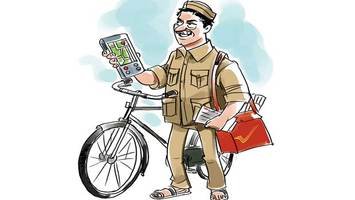
Maharashtra's 2,400 postsman's appointment scandal has been revealed. This disclosure has been made by the Vigilance Department.
Postmen scam in Indian postal department has also happened in Goa. Its evidence has been received by the Vigilance Department.
The complaint has been filed with the Mumbai Police, after which the police has registered an FIR against Manipal Technology Limited (MTL).
In fact, this company was tender for the postman's appointment in the postal department in 2015. In this tender he was also given the appointment of a male guard along with the postman. The police has registered this FIR on the complaint of the Mumbai Assistant Post Master General.
The name of PV Mallya is coming out in this scandal. The hearing is going on in the Mumbai High Court about the scam. In this, Justice A M Badar has refused to grant bail to Mallya before arrest. This verdict was pronounced by the court on November 3.
Let me tell you that there is BJP government in Maharashtra and Goa.
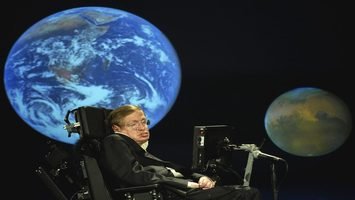
Famous physicist Stephen Hawking has once again warned mankind. He said that in order to preserve mankind's existence, mankind should soon find another earth or planet.
In his interview to Wire Magazine, Stephen Hawking said that the world is facing highly environmental and technological challenges and needs to work together and unite together to protect humanity.
He said that we now have the technology to destroy our planet, but the ability to escape from it has not developed so far. Maybe in a few hundred years we will settle human habitations between stars, but at the moment we have only one planet and we need to work together to save it.
The famous scientist Hawking said that Artificial Intelligence will cause the destruction of humans on Earth. He said that I am afraid that Artificial Intelligence will force humans to migrate from Earth to another. In such a situation people should find their new location soon on other planets during the time.
American scientists have created two new molecular editing equipment on Wednesday. This will help to fix the mutations. Mutations cause many diseases, some of which have no cure.
David Leu of Howard University and the Broad Institute of MIT and Harvard provide a very accurate way to correct the mistakes of gene, which are made of Deoxyribonucleic acid or DNA.
A second discovery by the molecular biologist Feng Zhang of the Broad Institute, which focuses on editing ribonucleic acid or RNA. It does genetic direction to make the protein without replacing the DNA.
India's doctor or primary care consultant gives patients two minutes only. It has been revealed by a research. This is revealed in the largest international research on medical consultation.
The situation is even worse in neighboring countries of Bangladesh and Pakistan, where consultation time is only 1.3 minutes from 48 seconds.
This research was published on Thursday in Medical Journal BMJ Open. In contrast, in countries like Sweden, America and Norway, the average time of consultation is 20 minutes.
This research was done by researchers from many hospitals in the United Kingdom.
It has been said in the journal, "It is a matter of concern that 18 countries where 50 per cent of the world's population live. The average consultation time here is 5 minutes or less.
According to the study, patients are spending more time on pharmacy or eating antibiotics and their relationships with their doctors are not as good.
Reduction of consultation time means that there is a big problem in the healthcare system. In the context of India, local experts say that these hospitals show crowd and a lack of primary care physicians. Primary care doctors are different from consultants who are trained in a particular branch of medicine.
Nobody was surprised by the fact that the consultation in India got two minutes. Health commentator Ravi Duggal says, "Everyone knows that doctors are able to give patients less time due to crowding in hospitals."
According to Dr Duggal, "There is no new thing that doctors get confused with the symptoms of patients."
In the private clinics and hospitals, this is also the case of the crowd. Here doctors only ask questions and can perform very little physical examination.
There is a difference in diseases in the Western and Indian consultations. Dr. Suhas of Maharashtra explains, "In Sweden, patients have a Psychosocial problem rather than viral fever. In the same India, if the doctor has information about any particular virus in the air, then they can easily treat many people." In the BMJ Open Study, the poor condition of health services of many countries was noticed.
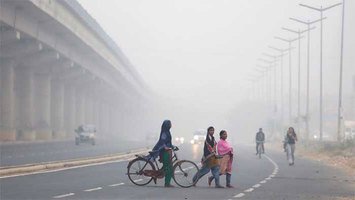
Air pollution reached a very serious level on Tuesday in India's Delhi. Due to the pollution exceeding the permissible standard (tolerant level), the entire Delhi was covered in a thick mist sheet.
Since last evening, the quality and visibility of the air has been declining rapidly and due to the combination of moisture and pollutants, the city has a dense mist.
On Tuesday morning till 10 a.m., the Central Pollution Control Board described the quality of air in very severe condition, which means that pollution has reached extremely dangerous levels.
In view of the current situation, fixed measurement under the Grade Response Action Plan (GRAP) by the Environmental Pollution Prevention and Control Authority (EPPCA) constituted on the directions of the Supreme Court can be used in which parking charges will be increased four times Includes.
If the situation is bad and persists for at least 48 hours then the workforce under GRAP can close schools and start the even-odd plan.
Last time, the air quality reached a very critical position on October 20, one day after Diwali. Since then, the level of pollution is constantly being monitored and the quality of air is maintained at a very bad level. This is a very serious situation, but according to global standards, it is also dangerous.
The quality of the air is extremely bad, it can cause problems related to snoring when people are exposed to it for a long time, whereas being at a very serious level means that It can also affect the healthy people and can affect breath and heart patients seriously.
Dipankar Saha, CPCB's Air Lab chief, said that the air is not running at all, due to which the situation was created. At the same time, seeing the poor quality of air in Delhi, the Indian Medical Association (IMA) has described it as extremely harmful to public health. Dr. K. K. Agarwal, President of IMA, has appealed to the school to close and not let people go out of the house.
The moisture present in the weather has stopped pollutants from sources located on the ground there. Skymate, the private agency of the weather, says that the neighboring Punjab and Haryana are burning large-scale straw and the air is entering the city at afternoon. In the neighboring city of Noida and Ghaziabad, the quality of air has been very serious.
The P. Vijayan government of Kerala has told the Supreme Court that the state police has conducted a thorough Investigation of a Hindu woman's acceptance of Islam and then her marriage to a Muslim person and did not find that the investigation of the case was done by the National Investigation Agency (NIA).
The Supreme Court had directed the NIA on August 16 to investigate that there is no broader aspect of alleged "love jihad" in this case.
In this case, the Hindu woman Hadia converted to Islam and accepted Islam and later married Shafin Jahan, a Muslim youth from Kerala.
The Kerala government said that he followed the court's directive to hand over the investigation of the case to the NIA, but the police has not yet detected any such crime so that the matter can be referred to the central agency by statute.
In December last, Shafin Jahan, who challenged the decision of the High Court to cancel his marriage, had recently filed an interim petition demanding the withdrawal of the order in which the investigation of the case was entrusted to the NIA.
He had claimed that the woman had converted from her marriage many months ago and marriage was decided through a marriage website.
In the additional affidavit, the state government said that the police was able to investigate and if a scheduled crime had surfaced it would have informed the Center.
The affidavit said, "The crime branch of the Kerala Police had examined in an effective and honest manner. There has been no incident of any scheduled crime in the investigation conducted by the Kerala Police so far that it should be informed to the Central Government under Section 6 of NIA Law 2008."
The state said in its affidavit, "Kerala Police has effectively investigated the above crime."
Shafin came to the Supreme Court then, when the Kerala High Court canceled his marriage and said that it is an insult to the freedom of women of the country.
Meanwhile, the Supreme Court said on October 3 that he will look into the question whether can High Court use his power under the writ jurisdiction for cancel of the marriage of Hindu women and Shafin Jahan.