In India, the Narendra Modi government of the Center will end the jobs of about 11,000 people from all zones of the railway. It is seen as a cut in spending.
The Railway Board has issued a letter to eliminate all the 10 thousand 900 posts from all the 17 Railway Boards while accelerating the exercise of deduction of expenditure. It has been written in the letter written to Railway Board's decision and all the General Managers that the decision to cut annual posts for the year 2017-18 should be implemented.
At present, the number of employees employed in Indian Railways is close to 15 lakh.
Let us state that during the campaigning of the 2014 Lok Sabha elections, the Prime Ministerial candidate and the current Prime Minister Narendra Modi had announced to give 10 million jobs every year, but it is not visible even after three years. The opposite government is ending the job of employees.
According to the letter, on May 25, the Central Railway Board's director (E & R) Amit Saran sent the order letter to all the zonal headquarters. This has stirred the staff in the railways.
Although the railway administration is telling it the normal process. According to officials, the railway terminates one percent post every year. However, the officials are giving clearance on the existing order that after review, it will be decided which non-usable posts will be terminated. The official also claims that the termination of such posts will not affect the functioning of the Railways.
Director of the Railway Board (E & R) Amit Saran has sent the order letter to all the zonal headquarters.
According to the letter, the South-East-Central Railway Zone has been asked to terminate 400 posts, while Central and Eastern Railway will be ended 1-1 thousand posts, East Coast Railway 700, Northern Railway to 1500, North Central Railway 150, 700 to North Eastern Railway, 300 to North Western Railway, 300 to East Central Railway, North East Frontier Railway to finish 550 posts. Similarly, the Southern Railway has been asked to eliminate 1500, South Central Railway 800, South East Central and South Eastern Railway 400-400, South Western Railway 200, Western Railway 700 and West Central Railway to finish 300 posts.
Ministry of Railways is working on the scheme of handing over 23 stations across the country to private companies. Modi government is going to give these to private companies under Public Private Partnership (PPP). For this, online auction will be organized on 28th June. The auction includes Kanpur Junction and Allahabad Junction of Uttar Pradesh, while Rajasthan's Udaipur Railway Station is also included. For the auction, the initial price of Kanpur junction is Rs 200 crore and Rs 150 crore for the Allahabad junction. The outcome of the auction will be announced on June 30. According to sources, the central government has decided to hand over 23 railway stations in the private hands.

In India's IT companies, the continuation of the removal of employees and reduction in salaries is continuing. Salary cuts have been done not only at the junior level but also at top level of companies. The big people who received low salary packages included Infosys CEO Vishal Sikka, Wipro's Azim Premji and IDEA's Kumar Mangalam Birla.
Their salaries have been seen cut in the financial year 2017. For poor payroll payments, the IT sector has been blamed for the turmoil and poor performance of the company.
In the compilation of Infosys CEO Vishal Sikka and Chairman of Wipro Azeem Premji, FY17 has cut more than 60 percent. This is due to global recession, stringent immigration and changes in automation in IT sector.
According to a recent report, the salary of Sikka reduced by 67 percent. This is because of the low bonus available. According to the annual report of Infosys, cash component of Sikka's salary in the financial year 2016-17 was Rs 16.01 crores, which is less than Rs 48.73 crores in the previous financial year (2015-16).
Similarly, Wipro Chairman Azim Premji's salary has been cut by 63 percent. 63 percent of the last financial year has been deducted in their salary compulsions. According to information given by the company to the US Securities and Exchange Commission, Premji received a $ 108,026 (about Rs 71.4 lakh) in the financial year 2016-17 as compared to $ 292,991 (Rs 1.93 crore) last year were met.
Similarly, the salaries of Kumar Mangalam Birla, Chairman of IDEA Cellular, owned by Aditya Birla Group, has declined manifold. Telecom operator IDEA recently told that it had to lose for the first time after becoming a listed company in the market. IDEA chairman Birla's salary was Rs 13.15 crores in FY16, but in the next financial year it has fallen several times to Rs 3.30 lakh. Aditya Birla Group has not given any commission to its chairman and other executives.
Explain that the IT sector is currently undergoing a global recession. Seeing this, there are reports of layoffs too long. Companies say that they are doing this to reduce their costs. Infosys, India's second largest company, had also cut off its senior and mid-level employees.
Former Prime Minister of India Manmohan Singh said on Tuesday that the country's development has slowed down, the main reason behind which is note ban and the economy is running on the engine of public expenditure only.
He expressed deep concern about the situation especially on the impact of employment generation. In his address at the Congress Working Committee meeting on Tuesday, he expressed concern over the decline in economic growth which is reflected in the GDP data for the last quarter.
In a meeting of the Congress Working Committee held at Congress President Sonia Gandhi's residence, Manmohan said, "India's GDP data for the fourth quarter of the last fiscal and the full fiscal year 2016-17 was released a few days ago. India's economic growth has come down drastically, primarily because of note ban declaration made in November 2016."
He said, "The actual sub-measurement of economic activities has resulted in huge and continuous reduction in Gross Value Addition (GVA). Private sector investment has collapsed and economy is running on the engine of the sole public expenditure. GVA of industries, which was 10.7 percent in March 2016, dropped to 3.8 percent in March 2017. This led to a decline of about seven percent."
The former Prime Minister described employment generation as the most worrisome aspect. He said, "The most worrying thing in this is the effect of job creation. Getting employment for the youth of the country has become very difficult. The manufacturing industry, which has the highest employment generation in the country, is shrinking. This means that millions of jobs are going on in the country."
At a time when India's Hindu right wing group is questioning the contribution of the Mughal rulers in India, Uzbekistan's historian, the birthplace of Mughal Emperor Babur, has come here to study Babur and about that era so that the historical relations between the two countries can be traced.
A team of researchers from Central Asian countries visited the National Museum, which has a huge collection of information about the Mughal rulers, including the rare manuscript about Babar.
Babur founded the Mughal Empire which lasted for more than three centuries.
Experts are working on the 'Cultural Legacy of Uzbekistan in the Art Collections of the World' project, where the team is collecting the historical material from around the world.
Dr. BR Mani, Director General, National Museum said, "The party came in April and their goal is mainly documenting the contents related to the Mughal era."
He said, "Babar was born in the city of Andigen (Farghana province of Uzbekistan) and we have a lot of material about him and about Mughal dynasty in India. The other team will also go to the museum and we are happy to help them."
Babar did not actually visit Uzbekistan after coming to India. In the museum, there is interest in the manuscripts of Holy Quran especially for the experts of Uzbekistan which was given to the Mughal rulers and it is also clear from the imperial seal on the cover page. The Koran was written in Uzbekistan.
Mughal emperor Babar won the first battle of Panipat defeating Emperor Ibrahim Lodhi of the Lodi dynasty and established Mughal dynasty in India. Babur's son Humayun strengthened the Mughal lineage in India and coming the era of Akbar Mughal descent was well rooted in India.
The Kerala High Court has refused to intervene on the new rules of the Narendra Modi government to kill cattle. A public interest petition filed in the court against the dismissal of the government's decision was canceled by the court.
The High Court said that the protesters misunderstood the new rules of the Centre. According to Times Now, the High Court said that the order of the Center does not prevent anyone from eating beef.
The court said that there is no ban on killing cattle or eating meat. Only the sale of cattle in the big animal markets has been banned.
The Rajasthan High Court has asked the cow to declare a national animal. According to the news agency ANI, the High Court has told the Rajasthan government that those who killed the cow by changing the law should be sentenced to life imprisonment.
The High Court made this comment during the hearing of cows in Hinngoniya Gaushala. The High Court has ordered the forest department to plant 5000 plants in the cattle farms every year. At present, there is a provision of 3 years of punishment for cow slaughter.
On May 26, the Narendra Modi government banned the purchase of cattle in the cattle markets for the slaughter. Environment Ministry had notified the strict Animal Cruelty Prohibition (Livestock Regulation) rule 2017 under the Animal Cruelty Prevention Act.
But the Madras High Court has stayed the decision of the central government for 4 weeks and has asked for an answer in this regard.
Madurai Bench of the Madras High Court had said that deciding the people's 'food habit' is not the work of the government. While hearing a petition filed against Centre's decision in this regard, Justice MV Muralidharan and Justice CV Karthikeyan had said that selecting the food of their choice is a personal matter of all and no one can interfere in this right.
Many State Governments had opposed the decision to ban the sale of cattle in markets and mandis for slaughter.
West Bengal CM Mamta Banerjee had said that the central government has taken the decision without asking the states. The big controversy broke out in this matter, when in protest against this decision in Kerala's Kannur, Youth Congress workers publicly cut a calf and divided it among the people.
The Youth Congress's program was a protest across the country. Congress Vice President Rahul Gandhi himself also condemned it.
Although Congress took action in this matter, two members of his party had shown the way out.
Students in IIT Madras also organized Beef Festival against this decision of the government.
Kerala Chief Minister Pinarai Vijayan has also targeted the central government's decision. He said that it is a violation of the constitutional and fundamental authorities of any person.
Vijayan said, "It has to be seen whether the central government has the right to order this order or not."
By banning the purchase of cattle in animal markets for slaughter by the Narendra Modi government, the centre-state relationship will be bad.
Earlier, the demand for independence was only in Kashmir. But now after the Modi government's ban on procurement of cattle, there has been a demand for Dravidnadu on Twitter in which demand for a separate country, including Kerala, Tamil Nadu, Karnataka and Telangana, is being sought.
The demand for Dravidnadu was made in 1940 by Periyar from the British. People had forgotten the demand of Dravidnadu after independence in 1947, but after the ban on procurement of cattle from the Modi Government, demand for Dravidnadu was started again.
Modi’s three-year anniversary was significant in ways more than one. It coincided with the Centre’s decision to ban sale of cattle for slaughter in animal markets across the country.
While some believe these restrictions will regulate illegal slaughter, others see this move as religious propaganda and a threat to human rights.
These new rules only ban cattle trading for slaughter in animal markets and not between individuals.
The restrictions were approved by former environment minister Anil Madhav Dave before his death last week, Hindustan Times reported. A Firstpost report says the government aims to improve the conditions of animals in these markets through the move.
All states except Kerala, Meghalaya, Mizoram and Nagaland already have strict cattle slaughter laws in place.
Cattle traders will now be required to give an undertaking that the animals brought to the market are being sold only for agricultural purposes. The purchaser isn’t allowed to resell the cattle for slaughter. Documentary proof is required to ensure the purchaser is an agriculturalist.
Before these rules were introduced, there were no records maintained or liability placed on cattle traders. The animals that were sold could be suffering from contagious diseases and could consequently be transmitted to consumers, told the managing director of Humane Society International/India to Firstpost.
CATTLE: The term cattle refers to cows, bulls, bullocks, buffaloes, steers, heifers and calves, as well as camels. 'Young' and 'unfit animals' cannot be sold. Cattle will now only be sold to a person who has documents to prove he is an 'agriculturist'.
If someone wants to sell their cattle for slaughter, it could be done legally outside the animal markets subject to slaughter rules implemented in each state.
The problem is, till now, majority of cattle trading was happening in animal markets. Over time, the animal markets had become a convenient site for farmers to make sales for slaughter and other purposes.
Additional precaution is to be taken regarding animal markets in border areas. The District Animal Market Monitoring Committee has been directed to ensure that no animal market is organised in a place which is situated within twenty-five kilometers from any state border or which is situated within fifty kilometers from any international border.
The rules, highly specific, will affect the poor and illiterate who will now have to go through hefty paperwork to buy a cow for agriculture and prove it is for that purpose only.
Scroll has reported that farmers’ unions see the new rules as an assault on agriculture. They said that in a time of distress, sale of cattle was one of the important ways through which a farmer overcomes financial difficulties. Enacting such stringent rules to regulate sale of cattle will push farmers further into debt.
Vijoo Krishnan, national joint secretary of the All India Kisan Sabha expressed his concern for the same, “To say you cannot sell the cattle for six months from the date of purchase or cannot sell infirm cattle will cripple the farmer in a drought situation.”
The impact will extend to industry and export – especially Muslim traders. DB Sabharwal, secretary general, All India Meat and Livestock Exporters Association, said that “90 percent of buffaloes are sourced from mandis by middlemen for sale in slaughterhouses against a mere 10 percent that is bought directly from farmers,” as reported by The Hindu. He adds he is skeptical about the implementation of this move as regulation of livestock falls under the purview of state governments and not the Centre.
While the Supreme Court has stayed out of this matter, the directive itself was in response to a 2014 writ petition by Gauri Mulekhi of People For Animals (PFA).
While the Supreme Court banned the bull-running sport jallikattu as cruel, it refused to intervene with states to frame a uniform policy on cattle slaughter.
Mulekhi told The Hindu that the rules will help greatly in eliminating the “middleman” from the process of buying and selling, and link farmers directly to slaughterhouses. “This will improve traceability, curb illegitimate slaughter and smuggling and, put the onus on cattle-owners to dispose of their animals responsibly,” she said.
Opposition parties have criticised the Centre’s move as being against the citizens’ right to food as well as diversity of religious faiths.
Kerala Chief Minister Pinarayi Vijayan said that the banning of sale of cows and buffaloes for slaughter was a “fascist and anti-federal move”. The Centre cannot prepare a menu for the people of the country, the state’s Left government told Hindustan Times on Friday.
An official statement from CPI also termed the decision as “most unwise” and alleged that it was taken by the RSS. It has been a long-standing demand of the RSS to ban cow slaughter across the country.
CMO Kerala tweeted, ''With effective ban on cattle slaughter, food consumption of millions affected. Clear attack on our plurality, the essence of India.''
Concerns have been raised in the Northeast as well. “It is a very bad decision. We don’t agree to it and won’t implement it,” said Mizoram’s animal husbandry minister C Ngunlianchunga.

Baba Ramdev, who is embroiled in the Indian market by taking everyday products from yoga guru to soap, oil and dental mangan, is no less than any brand icon today. To understand the basics of how they laid their coin, we have to follow a few steps. The year was 2014. Before the Lok Sabha elections, it is a matter of pre-election. The country was chosen to be PM. Narendra Modi and BJP were engaged to win. In such a situation, Baba had put his supporters on the streets to speed up Modi's chariot. As the mass base of Modi and his colleagues became strong. Just like Baba went into consumer products. Their Patanjali products are being used in the house to house. Shedding saffron chola, he became one of the successful interpreneurs of the country.
The story starts here. March 23, 2014 was a full afternoon. There were two weeks left for the Lok Sabha elections. Modi was in a public rally. Baba Ramdev also sat on the platform with him here. He whispered in the ear of Modi After a few minutes, he appealed to the people to vote for Modi. The results came two months after the rally. Congress was wiped out. The BJP came under the leadership of Modi.
According to the news agency Reuters' S Modi and his right wing base rises, So to does a celebrity Yoga Tycoon, according to the Investigative Report, after Baba Ramdev's company came to power in the BJP-ruled states, land acquisition was about 46 Million dollars (about 300 million rupees) was exempted.

Three weeks after a rally in Delhi, a trust of Ramdev had released the video on YouTube. In it, some senior BJP leaders were showing pose with the signed affidavit. The letter included things like protecting the cow and emphasizing on making things indigenous in India. This was the signature of Minister of External Affairs, Finance Minister and Transport Minister, who is also in the video.
Ramdev appears to be saying in that video that he has raised the hopes of a change in the crores of people. People want to see them fulfilled. That is why BJP leaders signed the affidavit. Senior BJP leader Lal Krishna Advani also signed it. Advani's PA, Deepak Chopra, said that he was the party's program and all BJP senior leaders had signed it. At the same time, Patanjali's knowledgeable person said that it was a matter of Ramdev's support, so senior BJP leaders gave their names.
In an interview last year in Haridwar, Baba Ramdev had said that for 200 years East India Company looted the country. Similarly, these multinational companies are selling their harmful chemical products in our country. Stay away from them. Ramdev becomes very emotional when referring to PM Modi. He talks about his relationship with Modi and says that Modi is my close friend. However, when the PMO was contacted for this story, the answer could not be found. When asked about his role in the success of Modi in 2014, Ramdev said that it is not good that you compliment him. I will not say much, but the major political changes have happened, I had prepared the background of them.
According to government documents related to land in the BJP-ruled states and interviews with officials, since the formation of Narendra Modi's PM, Patanjali acquired about 2000 acres of land for the factories, research facilities and creating the supply chains of herbs. Whereas during the Congress rule, the company sold a lot of its land. Two in the four acquisition cases, more than 100 acres were acquired (in BJP-ruled states). In BJP-ruled states, Patanjali got the benefit of 77 percent in buying of land. The company then promised to set up new factories and create new jobs.
Transport Minister Nitin Gadkari was also present during the cornerstone of Nagpur's Patanjali Food Processing Plant in September last year. In recording the program, Acharya Balkrishna, the MD of Patanjali, was told that he had raised the demand of a road for the factory. In response, Gadkari decided to make it a National Highway. Patanjali had paid Rs. 59 crores for 234 acres of land. This land was specific to the state's special economic zone, which had more than Rs 260 crores in the market. Patanjali was given land cheaply because he was not developed. There was no road to reach there.
The biggest transaction was in the eastern part of Assam in October and December 2014. In this 1200 acres were transferred. The documents show that this land was given free of cost for Patanjali Yogpeeth on the condition of preserving the cow.

In another area, Reuters' investigations found that the RSS was mobilized in that campaign, which was involved to stand up such Indian companies and its allies against the world's largest seed maker Monasto Company.
Only half a year after coming to power, the Modi government created a department of traditional Indian medicine under his ministry, which emphasized the use of yoga and Ayurvedic products. That is why Patanjali is today becoming a market leader. The ministry currently controls many products of Patanjali.
If PM Modi is the son of the tea seller at the station, Ramdev is also the son of a farmer. In the sixties, he was born in Haryana. Together with Balkrishna, he started making his own industry and Ayurvedic medicines in 1995. Then they had 3500 rupees. To work, both of them borrowed 10,000 rupees from someone.
Ramdev was involved in anti-corruption demonstrations in 2011 and coming to politics. In 2013, he termed Modi as the leader of the country. From here, he started supporting Modi.
Under Patanjali, a communication firm called Social Revolution Media and Research Pvt Ltd was also established by two directors jointly. According to the firm's CEO Shantanu Gupta, there were meetings with BJP's IT division in the week for the message coordinate on Twitter and on the other social media platforms.
All members of Ramdev's organization accepted to manage the votes for Modi by Volunteers. In May this year, at the inauguration of Patanjali Research Institute in Haridwar, PM Modi was seen clapping in honorable style towards Ramdev. Ramdev also bowed his head and greeted them.
Senior advocate Harish Salve is earning praise and gratitude across India not only for the Re 1 salary he charged to argue the case for Kulbhushan Jadhav at the International Court of Justice (ICJ) but also because the court has now ordered a stay on Jadhav's hanging by Pakistan till a final verdict comes.
However, he has said that India might move the United Nations Security Council (UNSC) if Pakistan does not abide by this order.
Conversely, Pakistan has argued that the ICJ does not have jurisdiction in the case of Kulbhushan Jadhav, who has been sentenced to death by a Pakistani military court on charges that he was an agent of Indian intelligence organisation Research and Analysis Wing (RAW) and was spying in Pakistan. Not happy with the ICJ order, which overrules its objections, Pakistan too may approach the UNSC. Either way, the UNSC seems to be the destination of both countries.
Salve, meanwhile, is turning out to be quite the force to reckon with for Pakistan. It was he who had pointed out that any order passed by the ICJ, like a stay on the execution of Kulbhushan Jadhav, would be binding on Pakistan, leaving authorities there fuming. He has now explained that India will approach the UNSC if Pakistan does not abide by the ICJ interim order not to hang Jadhav until it delivers a final verdict in the case.
Salve told the Times of India: "I do not think Pakistan will take the serious risk of facing the wrath of the UNSC by disobeying the ICJ order. If Pakistan dares breach the directive to hold its hands till a formal hearing on India's plea, it will be inviting dangerous consequences."
He added: "We had not appealed against the military court verdict before the ICJ. What we presented before the international court was that denial of consular access to India to its citizen in Pakistan was an international treaty violation, a lapse that possibly seriously breached Jadhav's right to adequate legal assistance. Who knows what could have been the outcome of the trial if Jadhav had full legal assistance from India during the trial?"
Salve's words may work as a salve for many a wound inflicted by Pakistan's hasty judgment on Jadhav, but they also highlight India's apprehension that Pakistan might just go ahead with Jadhav's execution despite whatever the ICJ has to say. The proverbial ball is now in Pakistan's court now.
The WannaCry malware-driven ransomware attacks have come like a sudden storm and as with most disasters, people are left wondering how they can prepare themselves for the next one. Given that WannaCry (also known as WannaCrypt, WanaCrypt0r 2.0 and Wanna Decryptor) is expected to mushroom as newer versions of the malware come out, here are some tips on how you can protect yourself in this increasingly dangerous world – whether WannaCry grows or dies out.
Ransomware is just one manifestation of cyberattacks, and in an era where cyberattacks on systems like power grids (and even airplanes) are a form of both warfare and a lucrative business for international crime syndicates, such headlines won’t end. And the more you do online and especially transact online – for instance, the Indian government’s focus on going digital and cashless is all about online transactions – you will increasingly face such dangers. It’s important you stay aware and as best protected as you can.
In this case, many systems running Windows XP have been affected. Windows XP runs around 60 percent of Indian ATMs, and noticed that even transportation systems like Mumbai Monorail’s rakes use Windows XP. A panchayat in Kerala has reportedly been infected with the WannaCry malware and there are reports of the West Bengal Electricity Board being affected. So, even if your system doesn’t go down, you may face difficulties, like ATM networks going on the blink and citizen and utility services coming to a standstill.
You’ve got life insurance and medical insurance, right? That’s because we see death and sudden illness as risks. It’s time you see cybersecurity as a similar risk. And therefore, see investment in a security solution (whether it’s for a single PC, a smartphone, or a small company) as an investment that will pay off during the unexpected, because such attacks never come with a warning. And if you are a home user, some of the free options are quite good too.
The only way out for those hit by WannaCry is to ensure removal of the malware from their system and use backed-up data to get back to work. Data encrypted by the malware cannot be recovered and there’s no evidence that the criminals behind the malware are sending keys even if you pay them the ransom.
And while cloud back-up is an excellent option, get yourself offline backup too to ensure all your data is backed up to a secondary location. Try and back-up at least once a week, or simply use apps that can ensure automated back-ups.
Whatever operating system you use, make sure auto-updates are on, or at least make sure you follow update releases and install the latest software. Microsoft released an update that patched the vulnerability that WannaCry exploited way back in March. But it’s clear many organisations and users didn’t bother to install the update. And the result is clear for all to see.
Sure, WannaCry doesn’t affect MacOS (in fact, it doesn’t affect Windows 10 either), but ransomware has been found even for MacOS and mobile OSes like Android. In fact, if you get overconfident, the bad guys can use it in attacks that leverage social engineering.
For those on Windows XP and Windows 8 and using pirated software, the Microsoft patch can still be used. However, on a regular basis, you will not have access to auto updates if you use pirated software. Given the high degree of cyber risks, it simply doesn’t make sense to save a few rupees and use pirated software.
There are many options that are now available on a pay-as-you-go, Software-as-a-Service basis. You don’t need to make massive up-front investments. Security as a service is here to stay and in an era of automated threats like Wannacry you should ensure your security is automated too, and responds in real-time to proactively protect your business.
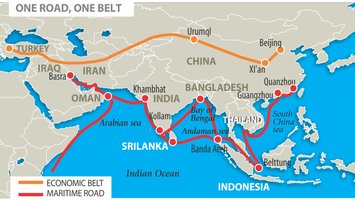
In the ancient days, China, and much of East Asia, was connected to the rest of the world through a route that got its name from China’s biggest export - silk. Today, the country is looking to rebuild a route that will connect Asia, Africa and Europe - a new Silk Road.
The One Belt One Road (OBOR) initiative will include roads, railways and ports and seems like a natural step for the world’s biggest trading country. After all, Asian Development Bank has said that the region, which is home to 60 percent of the world’s population, requires over $26 trillion in investment by 2030 to keep economies growing.
But the rest of the world - especially India - isn’t very happy about a project that it sees as not simply an economic initiative but as a means to push political influence and change status quo in some places. Kashmir, for example.
Chinese President Xi Jinping’s baby, the One Belt One Road was announced in 2013. Since then projects have been launched in various countries like Tajikistan, Thailand, Kenya and Vietnam financed by Chinese loans.
While some countries like Pakistan and Afghanistan are keen on OBOR, countries like India and Indonesia are wary because of the shift in status quo that this project could cause in sensitive areas like Kashmir and the South China Sea.
Chinese officials, however, reject the suggestion that the OBOR is a power play.
“The Chinese government has never wished to control any other country’s government,” a Cabinet official, Oi Xiaoli, told The AP. “We feel in contacts between countries, we need to talk about studying benefits, studying mutual profit.”
But Why’s India Worried?
As part of the OBOR, in Pakistan, there is a proposed $1.3 billion effort to expand the Karakoram Highway as part of the China-Pakistan Economic Corridor (CPEC). Now this involves power plants, roads and railways that will span the length of Pakistan and link China’s western region of Xinjiang to the Gwadar port, which was built with Chinese help.
But the CPEC runs through Pakistan-occupied Kashmir.
The establishment of a project with China in the disputed territory gives Pakistan’s occupation of the area a degree of legitimacy. And India’s clear stand on the issue is that Pakistan is illegally occupying Indian territory. Getting on board OBOR or talking to China and Pakistan about CPEC would be problematic for India as it could be seen as conceding ground to Pakistan. It would also involve a third country which goes against India’s stand that this is a bilateral issue which needs to be worked out between the two neighbours.
China held a conference centred around OBOR in Beijing and heads of states, governments and representatives from 29 countries and international organisations were present, including the US, Russia and the IMF. India stayed away from it but the global representation definitely legitimised the initiative.
Vladimir Putin, President, Russia Poverty, social chaos... the development level of countries and regions – all this creates a breeding ground for international terrorism, extremism as well as irregular migration. We shall not be able to live up to these challenges should we fail to overcome the stagnation of the global economic development.
Antonio Guterres, Secretary General, United Nations It is in our shared interest to show that the global economy can serve all the world’s people.
“Peace and development go hand in hand. ‘One Belt, One Road’ signifies that geo-economics must take precedence over geopolitics and that the centre of gravity should shift from conflict to cooperation. We see it as a path for overcoming terrorism and extremism,” said Nawaz Sharif, Prime Minister, Pakistan
Recep Tayyip Erdogan, President, Turkey This is going to be the kind of initiative that will put an end to terrorism.
Henry Paulson, Former Treasury Secretary, United States of America I know the United States has been among those countries apparently most skeptical of the ‘Belt and Road’. Simply put, the more China can demonstrate that the ‘Belt and Road’ initiative is open to outside participation in this way, the more it will be embraced by global and even American firms and suppliers.