British historian Louis De Aisis Koraiya has revealed the most important on the life of Mughal Emperor Akbar. Koraiya says that Jodhabai is said to be Akbar's wife, but in fact Akbar's wife Jodhabai was not. Koraiya says, Jodhabai was actually Jahangir's wife.
London's British historian Louis De Aisis Koraiya has been researching Portugal and Christians independently in India for the past several years. He has written 6 books so far, out of which he recently released a book titled 'Portuguese India and Mughal Relation (1510-1735)'.
In this book, the relationship between Akbar and Portuguese Maria Marcarnehas has been explained in a lot of detail.
He says that this relationship is not even mentioned in Mughal, Portuguese and English sources.
About Maria Marcarnehas, Koraiya writes, she had come from Lisbon to Goa with her younger sister Juliana in September 1558.
Koraiya writes in the book, that during that time the king of Portugal had the responsibility to protect the orphans of the sacrificers for the state and the girls of the age of marriage were sent to the colonies. But in the middle, the bandit attacked her ship and both the girls were brought to the court of Sultan Bahadur Shah of Gujarat. Sultan Bahadur Shah presented both the girls in the Mughal court.
He writes, as soon as Akbar's eyes fell on Maria Marcarnehas of 17 years, he fell in love with her, and Akbar decided to make her his wife as soon as possible.
Koraiya says, Akbar's Haram has a lot of goods available to her, but still the Mughal Sources remain silent about this relationship.
He said that the most authentic document about Akbar's life is believed to be 'Akbarnama' written by Abul Fazal, but there is nothing written in this regard.
At the same time there is no mention of Maria in the Mughal Source Al Badayuni.
According to Koraiya, due to a fierce relationships between the Mughal and the Portuguese, they did not say that Akbar had a Christian wife.
Koraiya said that Jodha Bai is not a woman who is referring to her as Maria.
Koraiya says that neither in Akbarnama or nor Jahangir's mother, Jodha Bai is mentioned.
He said, in this period, no mention of any person of this name (Jodha Bai) is also in the Persian record.
Who historian mentions Jodha Bai, he is historian James Todd. But he refers to her (Jodha Bai) as Jahangir's wife and Shah Jahan's mother.
Koraiya claimed that Jahangir's mother was Portuguese Christian (Maria Marcarnehas) who was called Mariyam-Uz-Zamani.
Koraiya says that Jahangir always used to wear a Cross of a gold chain.
Koraiya says that Jahangir was half a Christian and had a picture of Jesus in his palace and he used to spend a day in a week in the Jesuit House in Agra.
(Perwez Anwer has been a student of History Department of Jamia Millia Islamia, New Delhi, and is the founder, CEO, Director and Editor-in-Chief of IBTN GROUP.)

The big news is that there is a huge shortage of Gazetted officers in Border Security Force (BSF) between the unrest in the Indo-Pak border and Jammu and Kashmir. 60 percent of the total people selected this year have refused to do join.
All this happened after the video posted by BSF jawan Tej Bahadur Yadav and the unrest on the Indo-Pak border.
A total of 28 people were selected in the UPSC exam in 2015. He was to join the BSF in the post of Assistant Commandant in 2017. But 16 officers refused.
For the past few years such situations have started to grow. In 2016, only 31 were selected, out of which 17 started taking training. But 14 officers did not join.
In 2013, 110 were selected from the examinations of which 69 started taking training, 15 of them left during the training.
According to the data of the Home Ministry, there are a total of 5,309 posts of gazetted officers in BSF, out of which 522 are vacant.
Some of them said that their first choice was not BSF. That's why they want to read further and prepare for CISF.
Some said that their goal is to become an IAS. Explaining the reason behind this, one said that the CISF will be posting in the cities, which will facilitate further study.
Some people also feared that obstacles in the promotion of BSF were stalled.
One person also said that in the eyes of the people, the Army's respect is more than the BSF jawans.
The second said that the first choice of marriage in Indian society is for the army, not the BSF jawan.
Speaking on this matter, a senior BSF official said that BSF, CRPF and ITBP are posting to the most difficult places. That's why people shy away from coming in. He also said that those who are not mentally prepared to come in it should not do join.
Many people in India and Pakistan media see evidence of the Pakistani media's strength against India.
At the same time, one of India's liberal channels, NDTV, dropped the interview of former Home Minister of India P Chidambaram, citing national security.
Radika Roy, co-founder and chairman of NDTV, said in a statement to the online publication 'The Wire', "Political splinter on the issue of surgical strikes, which was being used without evidence, was causing our national security to be damaged."
Pakistani journalists also feel that they are more brave and they can keep separate sides than their government's side compared to Indian journalists who support the government.
However, there can be no outcome of this debate. It proves that the freedom of the press is very bad in both countries.
Despite India being the world's largest democracy, despite its World Press Freedom Index published in 2017 by the 'Reporters Without Borders' Association, India is on the lower rungs on the scale of freedom of the press.
According to the World Press Freedom Index published in 2017, India's 136th position in the list of 180 countries shows that the freedom of the press in India is constantly worsing.
India is far behind countries like Zimbabwe and Myanmar.
Norway, Sweden and Finland are the world's leading journalists in bold journalism.
In this case, China is ranked 176th and Pakistan is ranked 139th.
'Reporters Without Borders' has said in its report, "The independence of the press in India is threatened by Modi's nationalism and the media is not printing news due to fear."
According to the report, "Self censorship is increasing in the Indian media and journalists are targets for the online campaign to defame the hardline nationalists. Journalists who are critical of the government are being prosecuted to stop them. "
In India, four journalists were killed in 2015 and at least one journalist has been attacked every month. In many cases, criminal cases have been registered against journalists. The result has been that journalists have put themselves on the censorship.
"The scope of these attacks is shocking. In the name of national security, the Internet and newspapers were banned in Kashmir. There have also been incidents of defamation of corporate fraud, murder of independent journalists after reporting on corruption of the local Mafia and Chhattisgarh's security forces tortured and sent to jail independent journalists," says Geeta SeShu of the media watchdog The Hoot Dot ORG.
Given the current tension in India's Kashmir, the government has imposed various types of curb on the freedom of the press. Journalists were not passed during the curfew, journalists were attacked, the dissemination of newspapers in the state was stopped, and the newspaper, Kashmir Reader, was completely banned.
If a newspaper was banned in any other part of the world, it would have been a ruckus, but the Indian media has largely ignored it.
Senior journalist Rajdeep Sardesai writes on this, "Today the World Press is the Independence Day. India is 136 and Pakistan is ranked 139th. A lot has been said. Greet those selected people who are still raising the voices."
In his next tweet, Rajdeep wrote, "The truth is that the press has a great tradition of freedom in India. This freedom has been misused due to business models and personal interests.''
At the same time, former Justice Markandey Katju wrote on Facebook, "World Press Independence Day is the world's biggest manipulation. Press freedom is a myth and a cruel joke with the public.
He wrote, "The world is in the hands of the corporate, whose sole purpose is to make maximum profit. Actually there is no press freedom."
Katju wrote, "Big journalists take a heavy salary and for this reason they have become accustomed to fancy lifestyles. They will not want to lose it and therefore only follow orders and lick the lamps."
The situation of democracy in Pakistan is also shaky, extensively in Pakistan, so it is not surprising that Pakistan is at 139th position in the World Press Freedom Index. These rankings do not match the claim of Pakistan's free media.
The Report of Reporters Without Borders of the 2016 said about Pakistan, "The targets that the journalists make are included in the extremist groups, Islamic organizations, intelligence agencies. They obstruct the freedom of the press. They all are fighting each other, but as always they are ready to hurt the media. In such cases, news organizations have adopted self-censorship."
Raza Rumi, a Pakistani journalist living in the United States in Pakistan attacked the assassination of the murderer in 2014, and says, "As far as Pakistan is concerned about national security, in some places in English newspapers to express different views But the opposition of the power establishment in TV news is quite dangerous. Institutions do not allow it."
Rumi used to host a TV show and had argued differences with Pakistan's foreign policy and raised the issue of rights of minorities.
During reporting on the issue of human rights in Balochistan, there was a fatal attack on the famous Anchor and journalist Hamid Mir in 2014. Then Mir's brother came to the TV channel and blamed the Pakistani army for the attack.
By the way physical assault and direct censorship - a small part of the problem is full, efforts to curb media in India and Pakistan are increasing.
In the telegraph newspaper Manini Chatterjee wrote, " Perhaps any one rarely know difference between censorship-self censorship, truth-propaganda and journalism-blind nationalism devotion."
Not only that, the Bharatiya Janata Party government led by Narendra Modi in India has reduced the methods of reaching journalists till the news and has promoted PR so that news of media can be controlled in a better way.
There is more pressure from the army in Pakistan. Ayesha Siddika's articles which consistently write on Pakistan's security policies are rejectioned several times in Pakistan and they appear to be more in India.
Ayesha Siddika wrote in the Pakistani newspaper The News, "At present, the head of the Inter Service Public Relation is Lieutenant General, the PR Agency of the Army is running a large-scale radio channel today, there is a stake in many TV channels. Finance to the film and the theater. It is not just an institutional extension, but it is a matter of shaping the voice of the country (Pakistan) media."
Journalists in Pakistan are not allowed to go freely in Balochistan. In such a situation, which country's media is more free, there can be no outcome of this debate.
The freedom of the press in both India and Pakistan is going through a period of serious danger.
Railway Minister Suresh Prabhu has become tough on the late trains. He has issued instructions to the officials of the Railway Board and said that all trains should be run on their appointed time.
Refuting the officials, the Railway Minister said that if the late trains continue, the officers should be prepared to face the consequences.
Railway Minister has given this order after reports of late trains in the media. In fact, the www.trainsuvidha.com has issued a report on the late trains between January 1 and March 31 in the last four years. In the year 2017, the number of such trains has increased three times since 2015, which is more than 15 hours late. In 2015, the number of trains which were more than 15 hours late was 479 which increased to 1337 in 2017. These trains also include the country's most important Rajdhani and Shatabdi Express trains.
According to the website, Rajdhani Express 53 times, Shatabdi Express 19 times, Garib Rath 46 times, Superfast trains 86 times and Express trains 451 times have reached delay in their destination in the year 2017.
According to the website, the number of trains reaching more than 15 hours delay in the year 2017 are 1337, which were 165 in 2016. Similarly, the number of trains running late by more than 10 hours were 1382 in 2017 and 430 in 2016. The number of trains delaying more than five hours were 4613 in 2017 and 2641 in 2016. The number of trains delaying more than two hours were 9564 in 2017 and 7441 in 2016.
The website has also released a list of the late 10 top trains. Seven of these trains pass through alone Bihar or Bihar. In such trains going to Bihar, the Swatantrata Senani Express is at number one, which lasted for 80 days between January 1, 2017 and March 31, 2017, and reached all the destination late. This train could not run on time in one day. In the 80 days, 41 days were like this when the train lasted more than 15 hours late. The second late train is the Udhayan Aabha Toofan Express, which ran for 75 days during this time and reached late over the destination. This train travels from Sriganganagar in Rajasthan to Howrah of West Bengal while in UP, Bihar. 32 days were like this when the train lasted more than 15 hours late.
Similarly, Barauni-Gwalior Mail lasted 60 days in 60 days late. The UP Sanpark Kranti Express lasted for 37 days late in a 67-day period. The Brahmaputra mail from Delhi to Dibrugarh has been lasted late all day in 42 days. Other trains going to late include Magadh Express, Bhagalpur Garib Rath Express, Amritsar-Howrah Express, Patna-Mathura Express and others.
Now the Ministry of Railways has instructed all the zonal heads and railway general managers to monitor the operation of trains between 10 am and 7 am and resolve the hassles of passengers to deploy senior officials. The experts say that the worst condition in the case of late is Danapur, Samastipur, Jhansi, Jabalpur, Varanasi, Mumbai, Allahabad Division Railway.
Attorney General of India Mukul Rohatgi has justified the Army in the Badgam district to build a human shield behind the Jeep and bind it to the Jeep.
He said that this was an effective solution to ensure that the demand for the situation was the same and that no one should die.
The Central Government of India has also cooperated with the military officer who decided to make the alleged stone man a 'human shield'.
Government of India has supported this move by the officer to protect their units, paramilitary soldiers and the officers of Jammu and Kashmir.
The government has taken cognizance of the investigation of the army which was set up on 9th April.
It has been stated in the investigation that the Commanding Officer took this decision as the last resort, hesitant because he felt that his unit had to pass through the roads where crowds of stone men were deposited and those who took positions on nearby rooftops. Among the soldiers who were stranded, there were dozens of local government employees, 9-10 ITBP soldiers, two constables of Kashmir Police and one bus driver.
Parliament has approved four bills related to commodity and service tax, while paving the way for implementing GST in the country's historical tax reform regime.
At the same time, the Government assured that the interests of consumers and states in the new tax system will be fully protected and tax on agriculture will not be levied.
The Rajya Sabha today discussed the Union Goods and Services Tax Bill 2017, the GST Bill, the Integrated Goods and Services Tax Bill 2017, the IGST Bill, the Union Territory of Goods and Services Tax Bill 2017, and the 'Goods and Services Tax to the States' bill 2017. After returning the Lok Sabha with a vow. The Upper House rejected the amendments of the opposition brought on these bills.
Due to the money bill, these four bills had the right to discuss only in the Rajya Sabha. The Lok Sabha has approved these bills on March 29.
Responding to a discussion on the Bill of Goods and Service Tax, Finance Minister Arun Jaitley said that these doubts of the Opposition are inexplicable, that in accordance with these bills, agreement with the rights of Parliament is being done in the matter of taxation.
He said that the first thing is that this Parliament has given the right to recommend the rate of tax to the GST Council by amending the Constitution.
Jaitley said that the GST Council is the first federal decision making body. On the basis of the constitutional amendment, the GST Council was given the right to form Model Law. As far as the law is concerned, it will be on the basis of federal structure, while the supremacy of Parliament and State Legislatures will continue. However, these recommendations will be kept in mind, because different states will set a different rate if there is a chaotic situation. This is a cordial interpretation of it and no other meaning should be drawn.
He said that by amending the Constitution, it has been ensured that it will be the only tax in the country to collect the state and the centre together. Explaining the situation on objections about having several tax rates instead of making a similar tax, the Finance Minister said that there are many food products which are now zero tax and there will be no tax after the GST system is implemented. There are many things that can not be taxed at the same rate. Rates such as tobacco, alcohol etc. are high, whereas clothing has a normal rate.
Jaitley said that during the discussions in the GST Council it was decided that many taxes will be simplified initially. The Finance Minister said that after the deliberations, the GST Council has fixed rates of 0, 5, 12, 18 and 28 per cent in GST system. It has also been said to put additional cess on material, such as luxury cars, bottled drinks, tobacco products and environmental related items like coal.
He said that the cess cost of more than 28 per cent will go to the fund and the states which are being damaged will be given the amount. There was also a suggestion that it should be applied as tax. But by applying as tax, there is an impact on consumers. However, additional taxes will not be levied on consumers.
Jaitley said compensation will be given to those states who are suffering from GST system implementation. It will be for the first five years. He said that Congress-led United Progressive Alliance government could not get a consensus on GST as no loss was given to the loss-making states for compensation. The provision of compensation in GST was 'helpful in the deal' and the state came together
Giving a clarification on the objection of several members after not including the real estate sector in GST, the Finance Minister said that this is an area in which the states get substantial revenue. It has revenue from the Registry and other tariffs, which is why it has not been included in GST on the basis of the opinion of States. He also clarified that the centre's vote is only one-third to take any decision in the GST Council whereas two-thirds of the votes are for the states. Therefore, while making any decision, the Centre is not in favour of imposing its own opinion.
Terming the first federal contract to get the constitutional clearance of goods and services tax, Jaitley said that, without putting any extra tax on consumers, there would be a way to implement a system of 'one nation, one tax' in the country through GST. The Finance Minister said that the GST Council is deciding the tax structure with unanimous consent and so far 12 meetings have been held in this regard. This bill is based on the principle of common sovereignty between the Centre and the State Governments and it is such a first initiative.
Upon the implementation of GST, the excise duty, service tax and value added tax (VAT) in the states will be included in it, along with several others. Jaitley, while clarifying the bills, said that the Centre has the right to tax in the event of the removal of the excise duty, service tax and additional customs duty through the central GST bill. Through the coordinated GST or IGST, there will be the right to tax the Centre on the movement of goods and services in states.
While clarifying the position regarding the provision to prevent profits in respect of tax exemption, the Finance Minister said that if 4.5 percent tax exemption is given, then it does not mean that it should be considered as a personal profit but the benefit should be given to the consumers. This is the intention of this provision.
The Finance Minister said that the situation was similar to liquor and petroleum products just like real estate. After discussions with the states, petroleum products have been brought under its purview, but it has now been kept under zero rate. The GST Council will consider it. Alcohol is still out of its scope.
The Finance Minister said that the first person had to go to many evaluation agencies for business. To pursue economic activities, it had to go through excise duty, service tax, state VAT, entertainment tax, entrance fees, luxury tax and many other taxes.
The Finance Minister said that there was no smooth flow of goods and services in the country. In this way, the GST system was further extended. Do such a tax where there is an evaluation officer. Most self-assessments and only limited appraisal except for audit matters.
Jaitley said that tax is taxed, which increases the trend of inflation. Therefore, the idea of making a market for the whole country. It came to be that simple arrangements should be brought inside the country. Describing agriculture to be brought under the purview of GST, the Finance Minister said that agriculture and farmers do not require registration. Under section 23, exemption is granted to farmers and agriculture. Therefore, it is kept in definition for interpretation of this exemption. There should be no confusion about this. Jaitley said that there should be no confusion about agricultural product when it is zero rate.
Dismissing Congress's objections about this, Jaitley said that 29 states, two union territories and the Centre considered this, including eight finance ministers of the Congress-ruled state. "Then did all these conspired against a particular class?" After dismissing the fears of an increase in the prices of commodity and commodities after the GST was imposed, the Finance Minister said that the rate of tax will be kept at the present level. It has no impact on inflation.
Jaitley said that the Jammu and Kashmir Legislative Assembly will bring a legislation about GST. He said that the Finance Minister of Jammu and Kashmir participated in all the meetings of the GST Council.
The Upper House rejected the draft of Trinamool Congress' Derek O'Brien, it said that all decisions of the GST Council should be approved by the Parliament.
The impact of climate change is not only on the environment, but it is also adversely affecting human health, especially on mental health.
The report released by researchers from the American Psychological Association and Eco-American researchers said that depression, anxiety and insomnia are increasing in humans due to conditions arising from global warming and it is becoming increasingly violent. It has also increased the risk of menstruation and people are becoming victims of 'Post Traumatic Stress Disorder' (PTSD).
What is PTSD
PTSD is a disease associated with many mental disorders such as severe depression, anger, insomnia. This makes the person more irritable, forgetting things. Difficulty concentrating in work, excessive vigilance, sudden blazing anger and sometimes the person becomes violent in the disease. There may be a sudden fear of having a heart attack during sleep.
Research on Hurricane Katrina Affected Areas
Researchers researched thousands of people affected by Hurricane Katrina in 2005, and found that after the storm, their thoughts of suicide increased.
49 percent victims of depression
Diseases of PTSD and Depression were found in 49% of the area. At the same time, they started feeling alienated at the social level.
Impact on resistance
Climate change also weakens the body's immune system. Due to the weakening of resistance, the risk of diseases increases.
Auto companies have announced huge discounts on two-wheelers of BS-3 standards in Delhi NCR. Companies have announced discount of 22000 rupees on motorcycles of BS-3 standards.
This announcement of the companies came just a day after the order of the Supreme Court which states that from April 1, orders have been issued to ban registration of two-wheelers with BS-3 standards.
Two leading two-wheeler makers such as Hero MotoCorp, HMSI, Bajaj Auto and Suzuki Motorcycle have announced a rebate of upto 22000 rupees on many of their models.
According to the report, 6 lakh 70 thousand bikes of eight lakh vehicles in the stock of companies in the NCR are BS-3 standard.
Dealers said they are trying to extract these vehicles from the earliest in the next 24 hours so that their minimum cost could be recovered.
Honda had initially announced a rebate of Rs 10,000 for its BS-3 scooters on its vehicles, but now this discount has been increased to motorcycles in the range of Rs 22000.
The models which are discontinued upto 22000 are Activa 3g (Price Rs 50,290), Dream Yuga (Rs 51,741), CB Shine (Rs 55,799 to Rs 61,283), CD 110 DX (Rs 47,202 to Rs 47,494).
Hero Motorcycle has announced a rebate of up to 12500 rupees in its BS-3 vehicles. The company has announced the maximum discount on its scooters.
At the same time, premium bikes have announced a rebate of Rs 7500 and a discount of 5000 rupees in the best-selling light motorcycles.
Federation of Automobile Dealers (FADA) Nikunja Sanghi, director (international affairs) told PTI, "Such a discourse has never been heard in the industry so far.
Asked what steps the dealer is taking in view of the verdict of the top court, he said, "Our emphasis is on selling as many vehicles as possible before the time limit." Our people are calling potential customers and telling them about exemption.
The Supreme Court yesterday said that the health of the people is more important than the commercial interests of the manufacturers. The apex court said that auto companies are fully aware that they have to manufacture only BS-4 standard vehicles from April 1, 2017, but despite this, they could not take any concrete steps themselves.
The Supreme Court has ordered that after April 1, vehicles with BS 3 emission standard will not be sold in India. The Supreme Court said that people's lives are more important than the business interests of the manufacturers. Since April 1 BS 4 standards are being implemented in the country. The number of ready BS3 vehicles in the factories is 8.24 lakhs, out of which six lakhs are two-wheelers.
The bench of Justice Madan Lokur and Deepak Gupta gave this order on Wednesday. Auto companies came to the Supreme Court against the implementation of the BS4 standard from April 1. In this case, the government had also supported the companies and had said that they should be allowed to sell the BS3 vehicles.
Indian companies and its dealers have a total inventory of two-wheeler vehicles of BS-3, which was about 6.71 lakh till March 20. Most of the vehicles are owned by two-wheeler companies Hero MotoCorp and Honda Motorcycle and Scooter India. Bajaj's share in this stock is around 12 per cent. Hero had nearly 2.90 million vehicles, while HMSI had estimated inventory of vehicles around 2.5 lakhs. Both companies are making full production BS-4 standard vehicles from March.
Retail inflation in India rose to 3.65 percent in February 2017, marginally higher than a month ago, showed data released by the government on Tuesday.
The increase in the consumer price index was in line with a poll of economists conducted by Bloomberg, which pegged inflation at 3.6 percent in February compared to 3.17 percent in January.
Retail inflation has been heading lower and hit a series-low in January. The decline stemmed mainly from the moderation in food inflation, especially in perishables, which were impacted by demonetisation. However, inflation excluding food and fuel (also known as core inflation) has remained sticky.
Data released on Tuesday showed that the decline in food prices is starting to reverse, pushing up headline inflation.
- Food prices rose 2.01 percent in February vs 0.61 percent in January
- Food and beverage prices rose 2.46 percent
- Fuel and lighting inflation increased 3.9 percent
- Clothing and footwear prices increased 4.3 percent
While retail inflation remains in check, wholesale prices surged in February due to higher commodity prices. Wholesale price index (WPI) based inflation rose 6.55 percent in February to its highest level in over three years. The divergence in the WPI and CPI indices widened to nearly 300 basis points in February.
The RBI warned of an increase in inflation pressures, partly due to an unfavourable base effect in a report on the macroeconomic impact of demonetisation released on Friday. The RBI saw upside risks to inflation as demand recovers in the latter part of the fourth quarter of fiscal 2017.
It added that the outcome of headline inflation in the near term will depend on “how food price dynamics evolve.”
The central bank had also raised concerns about core inflation at its last policy review in February, when it kept interest rates steady. This was cited as a key reason for the shift in the central bank’s stance from accommodative to neutral. While the RBI will likely meet its target of bringing down retail inflation to below 5 percent by March 2017, its medium term objective of 4 percent inflation remains in doubt.
The International Monetary Fund expects inflation to be at around 4.75 percent, “due to temporary demand disruptions and increased monsoon-driven food supplies” in early 2017. The multinational agency cited “supply-side reforms, particularly in agriculture, continued fiscal consolidation, and relieving impediments to monetary transmission” as factors crucial to keeping inflation in check, in its Article IV consultation paper on India released last month.
Briefing the media , ATS ADG, Law and Order Daljeet Choudhary on Wednesday said that the authorities have no evidence that link the suspected terrorists– Imran, Danish, Saifullah and Faizan – to any active module of the ISIS.
We have no information that links the four to any active ISIS module. From our initial investigations we suspect the four were self radicalised through material they found on social media.
He also revealed that the four wanted to identify themselves as the ISIS Khoran Moudle.
Sartaj, the father of the suspected terrorist who was killed in an anti-terror operation near Lucknow, said on Wednesday that he did not want anything to do with Saifullah’s mortal remains.
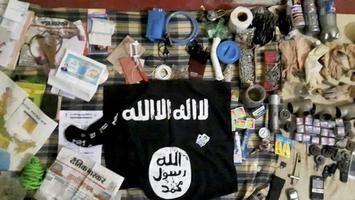
Saifullah was killed in a house on the outskirts of Lucknow after a 12-hour long operation by the Uttar Pradesh’s unit of the Anti Terrorism Squad. An Islamic State flag, eight pistols, 650 rounds of ammo, gold, SIM cards, cash, passports, a train timetable and explosive materials were seized from the house where Saifullah was holed up.
Expressing disappointment at his son’s actions, Sartaj said that he could not accept “a traitors body.”
Police suspect that Saifullah was involved in the 7 March blast in a Bhopal-Ujjain passenger train.
Speaking to the media, UP’s Additional Director General of Police said that Saifullah was a “hardened criminal,” who fired around 60 rounds of ammo on the commandos.
The anti-terror operation was being monitored by senior officials. After opening the doors of the house (where the terrorist was holed up), the force went inside and found the suspect dead along with his weapons.
Raids were conducted in different cities of UP, including Etawah and Kanpur, after the police force received inputs from Telangana regarding the terror suspects involved in the Bhopal-Ujjain train blast on Tuesday.
Two suspected terrorists were arrested and taken to Lucknow by a team of the Uttar Pradesh Anti-Terrorism Squad for further questioning.
Searches for the other terror suspects are also underway.
Superintendent of Police (Kanpur City) Somen Verma said a team of UP ATS left for Lucknow with the two terror suspects at around 3am on 8 March, for further questioning.
Speaking to reporters after the anti-terror operation, IG ATS Aseem Arun said: "Efforts were made to catch the suspected terrorist (identified as Saifullah) alive, but unfortunately this did not materialise. We fired tear gas shells and chilly bombs but he did not come out."
The ATS commandoes then stormed inside the house (after issuing a warning to the terrorist), Arun said.
The suspected terrorist then fired at the ATS commandoes, which was then appropriately retaliated by the ATS commandoes. After this, two rooms were thoroughly searched and checked, and the person identified as Saifullah was found dead... The slain terrorist belongs to the Khurasan module of the ISIS and was an active member. But, whether he has been indoctrinated or not is a matter of investigation.