Magazine

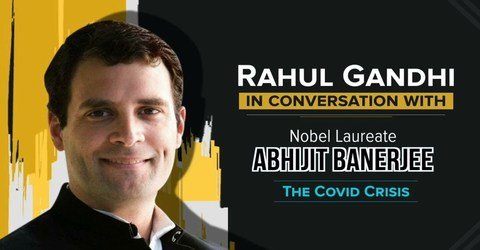
Rahul Gandhi in conversation with Nobel Prize winner Abhijit Banerjee on COVID 19 & its economic impact, Episode - 1

Important dialogue between former National President of the Indian National Congress, Rahul Gandhi and Nobel Prize winning economist Dr. Abhijeet Banerjee on the Corona epidemic, the future economic challenges due to it and how to deal with these economic challenges.

Rahul Gandhi: First of all, thank you very much for your time. You are very busy.

Dr. Banerjee: No ... no ... no more than you.

Rahul Gandhi: It doesn't seem like a little dream that everything is closed.

Dr. Banerjee: Yes, it is like a dream, but frightening, in fact it is such that nobody has any idea what is going to happen next?

Rahul Gandhi: You have children, so how does it feel to see them all?

Dr. Banerjee: My daughter is a bit upset. She wants to go with her friends. My son is young and he is happy that his parents are with him all the time. It is nothing wrong for him.

Rahul Gandhi: But there is also a complete lockdown. So they can't go out?

Dr. Banerjee: No, no, it is not, we can go out. There is no restriction on walking, there is no restriction on cycling and driving. It is just that we cannot go together, maybe it is banned.

Rahul Gandhi: Before I begin, I have an eagerness. You received the Nobel Prize. Did you expect Or did it happen suddenly?

Dr. Banerjee: It was very sudden. I think it is such a thing that if you keep thinking about it, then you sit with it in mind. And I am not a person with things in mind, especially for things that have no immediate effect on my life. I don't expect anything ... It was a surprise for me.

Rahul Gandhi: It was a great thing for India, you have made us proud.

Dr. Banerjee: Thank you ... Yes, that's a big deal. I am not saying that this is not a big deal, I believe that you sit with this in mind, but it is not that there is a process that everyone should understand. So, things happen.

Rahul Gandhi: So one of the important things that I want to discuss with you is the impact of Kovid and lockdown and the economic devastation of poor people. How do we see it? There has been a policy framework in India for some time, especially when we were in the UPA, we used to give poor people a chance, like MNREGA, right to food, etc ... and now this much work was done, bypassing it Is going because the epidemic has come in the middle and millions of people are falling into poverty. This is a big deal ... what to do about it?

Dr. Banerjee: I think it is two different things. In a way, I think that the real problem that immediately arises is that the good policies that the UPA had framed are inadequate at the moment. The government has adopted them in a way. It is not that there was any discriminatory disagreement on this. It is quite clear that UPA policies would work for whatever could have happened.

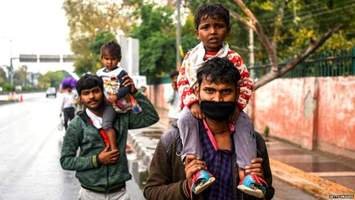
The difficult task is to do for those who are not part of these policies or schemes. And there are many such people. Especially migrant laborers. The plan that was introduced in the last year of the UPA regime was that Aadhaar should be implemented across the country and used for PDS and other schemes. You will get the benefits of Aadhaar, wherever you are. There is a great need to implement this scheme at this time. If we look back, it could have saved many people from trouble. If this happens, people would go to the local ration shop and show their Aadhaar that I am the beneficiary of PDS. For example, even though I am from Malda or Darbhanga or anywhere, I can take advantage of it in Mumbai. Even if my family lives in Malda or Darbhanga. But here is my claim. And if it did not, then it means that there is no system for many people. They are also not eligible for MNREGA because there is no MNREGA in Mumbai, and could not even be a part of PDS as they are not local residents.

Actually the problem is that while designing the welfare schemes, the thinking was that if someone is not at his place of origin then it is assumed that he is working and he is earning. And that's why this system collapsed.

Rahul Gandhi in conversation with Raghuram Rajan on COVID19 and its economic impact, Episode - 4

Rahul Gandhi: I am surprised to see how important environment and trust are to the economy. What I see among the Corona catastrophe is that the issue of trust is the real problem. People do not understand what is going to happen next. There is a fear in the whole system. Talk about unemployment, there is a big problem, there is a large scale unemployment, which is going to be huge now. How do we proceed for unemployment, when we get rid of this crisis, how will we deal with unemployment in the next 2-3 months?

Raghuram Rajan: The figures are very worrying. Looking at the statistics of CMIE, it is found that about 11 crore more people will become unemployed due to Corona crisis. 5 crore people will lose their jobs, about 60 million people will be out of the labor market. You can raise questions on a survey, but we have these figures in front of us and these figures are very broad. This should make us think that we should open the economy by weighing it, but as fast as possible, it will have to be done so fast that people start getting jobs. We do not have the ability to help all classes. We are a relatively poor country, people do not have much savings.

But I ask you a question. We have seen a lot of measures in America and Europe has taken such steps keeping in mind the ground reality. The Government of India has a completely different reality that it is facing. What do you think is the difference between dealing with the situation in the West and India's ground reality?

Rahul Gandhi: First of all scale, the enormity of the problem and the financial system at its core is the problem. Inequality and the nature of inequality. Caste problem, because the system that Indian society is in is completely different from American society. The ideas that are pushing India back are deeply ingrained in society and hidden. In such a situation, I feel that India needs a lot of social change, and this problem is different in every state. The politics of Tamil Nadu, the culture there, the language there, the thinking of the people there is completely different from the people of Uttar Pradesh. In such a situation, you will have to develop arrangements around it. The same formula will not work, cannot work for the whole of India.

Also, our government is completely different from the US, in our system of governance, there is a thinking of control in our administration. We have one DM (District Magistrate) as compared to a producer. We only think about control, people say that it is so since the British era. I do not believe so. I believe this is a system even before the British.

The way of governance in India has always been control and I think that is the biggest challenge before us today. We are unable to control corona disease, so as you said, it has to be stopped.

Another thing that bothers me is inequality. This has been the case in India for many decades. As inequality is in India, it will not be seen in America. So whenever I think, I think how to reduce inequality because when a system reaches its high point then it stops working. You will remember Gandhiji's sentence that go to the end of the line and see what is happening there. This is a big lesson for a leader, it is not used, but I think a lot of things will come out of here.

How do you deal with inequality? This is also visible in the corona crisis. That is, the way India is treating the poor, how are we adopting the attitude of our people? There are two different views about migrant versus thriving. There are two different India. How do you combine these two together?

Raghuram Rajan: See, you know the bottom of the pyramid. We know some ways to improve the lives of the poor, but we have to think carefully so that we can reach everyone. I believe that many governments have worked for food, health, education and better jobs, but the challenges that I feel are administrative challenges. In my view, the big challenge is from lower middle class to middle class. Their needs are jobs, good jobs so that people do not depend on government jobs.

I believe that there is a need to work on this front and in view of this it is necessary to expand the economy. We have seen our economic growth falling over the last few years, despite the fact that we have an army of young workers.

So I would say not just go to the possibilities, but create opportunities that flourish. Even if there have been some mistakes in the past years, this is the way to move forward. Think of the way in which we have progressed successfully, moving into software and outsourcing services. Who could have thought that all this would become India's strength, but all this has come to the fore and some people argue that it came because the government did not pay attention to it. I do not believe so. But we should consider any possibility, give opportunity to the entrepreneurship of the people.

Rahul Gandhi: Thank you, thank you Dr. Rajan

Raghuram Rajan: Thank you very much, nice to talk to you.

Rahul Gandhi: Are you safe?

Raghuram Rajan: I am safe, Goodluck

Rahul Gandhi: Thank you, bye

Rahul Gandhi in conversation with Raghuram Rajan on COVID19 and its economic impact, Episode - 3

Raghuram Rajan: I believe that there is a reason behind this and that is the global market. It has become such a belief that if the markets are being globalized, then the firms participating in it also apply the same rules everywhere, they want the same system everywhere, they want the same type of government, because it gives them confidence Increases.

Local or national governments have taken away their rights and powers from the people in an attempt to bring uniformity. Apart from this, there is a craving for bureaucracy that if I can get power, I can get power, then why should I not get it. It is an ever-increasing craving. If you are giving money to the states, then there are some rules that you will get money only after obeying it and not without question you will get money because I know that you have also come by choosing. And you should get a sense of what's right for you.

Rahul Gandhi: These days a new model has arrived, that is the authoritarian or authoritarian model, which questions the liberal model. This is a completely different way of working and it is flourishing in more places. Do you think it will end?

Raghuram Rajan: I don't know. The authoritarian model, a strong personality, a world in which you are powerless, all of this is a very disturbing situation. Especially if you have a connection with that personality. If you think they believe me, they care about people.

The problem with this is that the rightist personality creates a belief in itself that, 'I am the people's power', so whatever I say will be correct. My own rules will apply and there will be no investigation, no institution, no decentralized system. Everything should pass by me.

Looking at the history, it will be known that whenever centralization has taken place to this extent, the systems have collapsed.

Rahul Gandhi: But there is something very wrong with the global economic system. It is clear that this is not working. Is it correct to say so?

Raghuram Rajan: I think it is quite right that it is not working with many people. The uneven distribution of wealth and income in developed countries is certainly a cause for concern. Uncertainty of jobs, the so-called uncertainty is another source of concern. If you have a job today, it is not known whether you will have a source of income tomorrow.

We have seen in this era of epidemic that many people have no employment. Both their income and security have been snuffed out.

Therefore, the situation today is not just a problem of slowing down the growth rate. We cannot just depend on the markets. We have to develop. We are also distressed by the inadequate distribution problem. Whatever development happened, people did not get the results. Many people missed. So we have to think about all this.

That is why I think we have to think about distribution system and distribution opportunities.

Rahul Gandhi: It is interesting when you say that people connect with the infrastructure and they get opportunities but if there are divisive things, hatred that people do not join - it is also a kind of infrastructure. At this time the infrastructure of partition has been erected, the infrastructure of hate has been created, and this is a big problem.

Raghuram Rajan: People benefit from social harmony. People need to feel that they are part of the system. We cannot be a divided house. Especially in such challenging times. So I would like to say that the constitution that our fathers, the nation-makers wrote and the rule given at the beginning, needs to be read and learned afresh. People now feel that there were some issues that were sidelined, but those were the issues that would have been teased, all our time would have been spent fighting each other.

Rahul Gandhi: Apart from this, you divide on one side and when you think about the future, you look back and look at history. What you are saying is right that India needs a new vision. What do you think that should be? Surely you talked about infrastructure, education, health services. How will all this be different from the past 30 years? Which pillar will be different?

Raghuram Rajan: I think you have to develop capabilities first. For this, better education, better health services, better infrastructure is necessary. Remember, when we talk about these abilities, they should also be implemented.

But we also have to think how are our industrial and market systems? Even today, we have the same system as the old License Raj. We have to think how to create such a system in which a lot of good jobs are created. There should be more freedom, more trust and confidence, but it is a good idea to confirm it.

Rahul Gandhi: I am surprised to see how important environment and trust are to the economy. What I see among the Corona catastrophe is that the issue of trust is the real problem. People do not understand what is going to happen next. There is a fear in the whole system. Talk about unemployment, there is a big problem, there is a large scale unemployment, which is going to be huge now. How do we proceed for unemployment, when we get rid of this crisis, how will we deal with unemployment in the next 2-3 months?

Rahul Gandhi in conversation with Raghuram Rajan on COVID19 and its economic impact, Episode - 2

Raghuram Rajan: You have to think on these two now. You cannot wait for the effects to come out because you are fighting the virus on one side and the whole country is in lockdown on the other side. Surely people have to provide food. The homes have to see the status of the migrants who have left, they need shelter, medical facilities. This needs to be done all at once.

I think it has to be set priorities. Our capacity and resources are both limited. Our financial resources are very limited compared to the West. We have to decide how to handle both the fight against the virus and the economy simultaneously. If we open now, then it will be like that we have come out of bed from illness.

The first thing is to keep people healthy and alive. Food is very important for this. There are places where PDS has not reached. Amartya Sen, Abhijeet Banerjee and I talked about the temporary ration card while talking about this subject but you have to see this epidemic as an extraordinary situation.

We need to think out of the box for what is needed. Decisions have to be made keeping in mind all budgetary limitations. We do not have many resources.

Rahul Gandhi: What do you think about the agricultural sector and the workers? What do migrant laborers think about? What should be done about their financial status?

Raghuram Rajan: In this case, direct benefit transfer is the way right now. Let us think about all the arrangements by which we reach the poor. We adopt many methods in widow pension and MNREGA itself. We have to see that these are the people who do not have employment, who do not have the means to livelihood and we will help them for the next three-four months as long as this crisis is there.

But, in terms of priorities, it would be most beneficial to keep people alive and not force them to go out in the midst of a lockdown in protest or in search of work. We have to find ways through which we can also reach cash to maximum people and also provide them food through PDS.

Rahul Gandhi: Dr. Rajan, how much will it cost to help the poor, to directly deliver cash to the poorest?

Raghuram Rajan: About 65,000 crores. Our GDP is 200 lakh crore, removing 65,000 crore from it is not a huge amount. We can do this. If this saves the lives of the poor, then we must do this.

Rahul Gandhi: India is in a difficult situation right now, but after the Kovid epidemic, can India have any major strategic advantage? Will there be some change in the world that India can take advantage of? How do you think the world will change?

Raghuram Rajan: Such situations rarely bring good conditions for a country. Nevertheless, there are some ways in which countries can benefit. I believe that after coming out of this crisis, the global economy needs to think in a whole new way.

If there is any chance for India, that is how we communicate? In this dialogue, we should think more than a leader because it is not a matter between two opposing parties, but India is such a big country that we should be heard well in the global economy.

In such a situation, India can find opportunities in industries, it can find opportunities in its supply chain, but the most important thing is that we should turn the dialogue in a direction that involves more countries, a multi-polar global system and not a bipolar system.

Rahul Gandhi: Don't you think there is a crisis of centralization? The power has become so centralized that the negotiations have almost stopped. Dialogue and communication solve many problems, but is this communication breaking due to some reasons?

Raghuram Rajan: I believe that decentralization is important not only for exposing local information but also for empowering people. It is the situation all over the world that decisions are being made elsewhere.

I have one vote to choose someone remote. I may have panchayat, may be the state government but there is a feeling among people that their voice is not heard in any case. In such a situation, they become victims of different powers.

I will ask you the same question. The impact of the Panchayati Raj that Rajiv Gandhi brought and how beneficial it proved to be.

Rahul Gandhi: It had a tremendous impact, but we have to say with regret that it is now decreasing. We are coming back from the progress that was made on the Panchayati Raj front and we are going in a district based system. If you look at the South Indian state, there is good work happening on this front, decentralization of the systems is taking place, but the centralization of power is happening in the North Indian states and the powers of the panchayats and land organizations are decreasing.

The more people the decisions are taken together, the more able they will be to monitor the decisions. I believe this is an experiment that should be done.

But why is this happening globally? What do you think is the reason that centralization is happening on such a large scale and the dialogue is ending? Do you think there is something at the center or there are many reasons behind it?

Raghuram Rajan: I believe that there is a reason behind this and that is the global market. It has become such a belief that if the markets are being globalized, then the firms participating in it also apply the same rules everywhere, they want the same system everywhere, they want the same type of government, because it gives them confidence Increases.

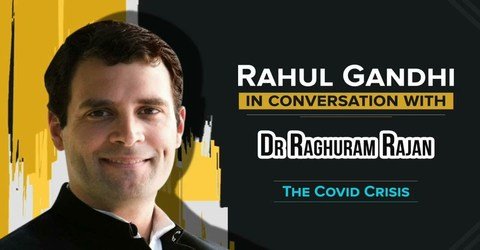
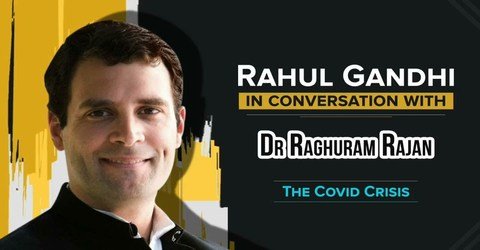
Rahul Gandhi in conversation with Raghuram Rajan on COVID19 and its economic impact, Episode - 1

Significant dialogue between former National President of the Indian National Congress, Rahul Gandhi and former Governor of Reserve Bank of India, Raghuram Rajan on the Corona epidemic, India's Modi government's claims to deal with it and the future economic challenges arising out of it.

Rahul Gandhi: Hello.

Raghuram Rajan: Good morning, how are you?

Rahul Gandhi: I'm good, nice to see you.

Raghuram Rajan: Me too.

Rahul Gandhi: In the era of Corona virus, there are a lot of questions in the mind of the people, what is happening, what is going to happen, especially with regard to the economy. I thought of an interesting way to answer these questions, to talk to you about it so that I as well as the common people can know what you think about all this?

Raghuram Rajan: Thanks, for talking to me and for this dialogue. I believe that at this critical time, as much information as possible can be obtained on this issue and it should be conveyed to the people as much as possible.

Rahul Gandhi: What I think is a big issue right now is how do we open the economy? What are the parts of the economy that you think are very important to open and what should be the way to open them?

Raghuram Rajan: This is an important question because as we try to reverse the curve of infection and prevent congestion in hospitals and medical facilities, we need to think about resuming people's livelihood Have to start. It is very easy to put a lockdown in the long run, but obviously it is not good for the economy.

You do not have a fixed security but you can start opening up areas that have relatively few cases, with the thought and policy that you will screen people as effectively as possible and when the case comes up you We will try to stop him and make sure that all the arrangements are in place to stop it.

It should have a sequence. First of all, we have to identify places where distance can be maintained, and this should not only apply to work places, but also to and from work. Transport structure has to be seen. Do people have personal vehicles? They have bicycles or scooters or cars. Will have to see all this. Or people come to work from public transport. How will you ensure distancing in public transport?

It will take a lot of work and hard work to make all this arrangement. At the same time, it has to be ensured that the workplace is relatively safe. Along with this, it has to be seen that if there are no accidental cases coming up accidentally, then how fast we can isolate people without implementing the third or fourth lowdown. If this happens, there will be a crisis.

Rahul Gandhi: Many people say that if we end the lockdown in a phased manner. If we open now and are forced to lockdown again. If this happens, it will be very dangerous for the economy because it will completely destroy trust. Do you agree with this?

Raghuram Rajan: Yes, I think it is right to think. Talking about the second lockdown, it means that we were not fully successful in the first time. This raises the question that if opened this time, then there will be no need for a third lockdown and this will bring credibility.

With this I would like to say that we talk about 100 percent success. That is, there should be no case anywhere. That is difficult to achieve at the moment. In such a situation, what we can do is to start removing the lockdown and isolate it wherever the case appears.

Rahul Gandhi: But in this whole arrangement it would be very important to know where there is more infection? And testing is the only way for this. At the moment there is a feeling in India that our testing capacity is limited. In a large country, our testing capacity is limited compared to the US and European countries. How do you see a small number of tests taking place?

Raghuram Rajan: Good question. Take the example of America. There are up to one and a half lakh tests a day, but experts there, especially experts in infected diseases, believe that this capacity needs to be tripled, that is, if there are 5 lakh tests per day, then you think about opening the economy. Some are talking about testing up to 10 lakhs.

Given India's population, we should test it four times. If you want to reach America's level, then we have to do 20 lakh tests everyday but we are only able to do 25-30 thousand tests now.

Rahul Gandhi: See now, the effect of the virus is there and after some time the economy will have an impact on the people. It will be a setback that is going to happen in the next two months. How can you balance the fight with the virus and its effects over the next 3-4 months?

Raghuram Rajan: You have to think on these two now. You cannot wait for the effects to come out because you are fighting the virus on one side and the whole country is in lockdown on the other side. Surely people have to provide food. The homes have to see the status of the migrants who have left, they need shelter, medical facilities. This needs to be done all at once.

Rahul Gandhi's conversation with Raghuram Rajan on the corona virus and its economic impact, Episode - 2

Korana crisis: is this the right time to take the case of the poor to court?

The Solicitor General of the Government of India says that the country is in crisis, so "shops of professional PILs should be closed".

He said this through teleconferencing in front of the Supreme Court justices Nageswara Rao and Deepak Gupta.

Solicitor General Tushar Mehta called the petitioners 'professional shopkeepers of public interest'. He objected to the petition being accepted for hearing. The court has given the central government seven April time to file its reply.

What was the petition? The petition was that the government was forced to migrate from the cities, giving financial assistance to the poor where they are. Former IAS officer Harsh Mander, advocate Anjali Bhardwaj and social activist Swami Agnivesh, who filed the petition, said the government had not taken adequate steps for the poor.

The Solicitor General had appeared as the representative of the government, so what he has said is the government's stand. One basic thing the government is saying is that this petition should be dismissed because there is a crisis on the country right now.

Is China hiding statistics about the corona virus?

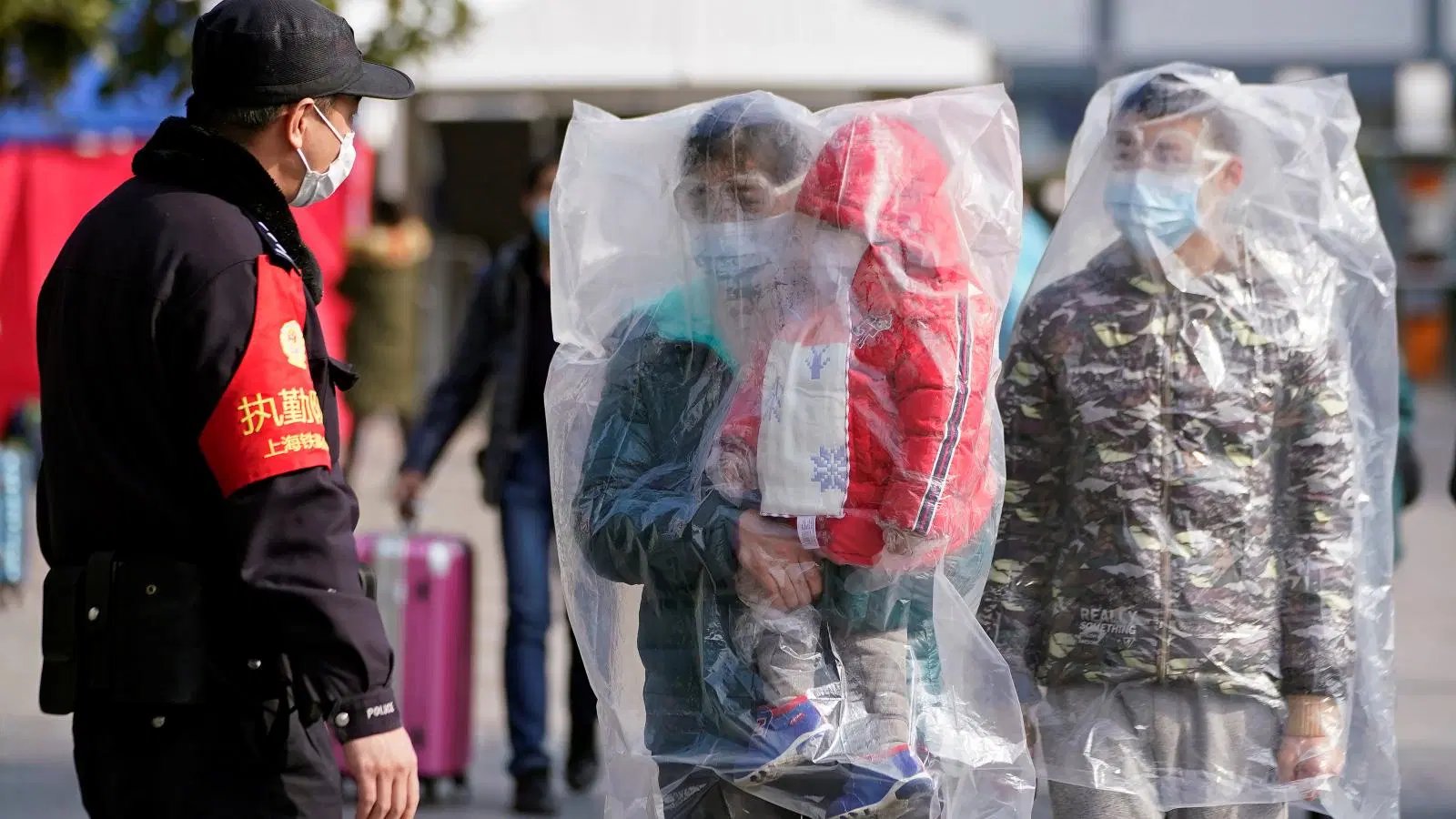
Corona virus infection started in China in November last year. China says that since then, the corona virus has killed 3,300 people. Now the corona virus infection has spread all over the world. Even more deaths have occurred in Italy, Spain and America than in China. There are all-round questions on the death toll in China.

It is being said that the statistics of death and destruction from Corona are being given by the Chinese administration, they cannot be trusted.

BBC News's China correspondent Robin Brant says on China's data, "The world has been skeptical of the data provided by the Chinese government. China's record in this case is very poor. These data are not incomplete but are designed intentionally. The Communist Party government here often works according to its goal. If he does not reach his target, then he hides the truth. Avoiding failures. In such a situation, the credibility of the Chinese government in terms of statistics has been doubtful. China has been refraining from showing actual growth even with GDP data.''

"There are similar doubts on the statistics of corona virus deaths and infections in China," says Brant. It was delayed by three weeks in release and delayed even after the infection spread. The number mentioned cannot be easily trusted. Just days after the infection spread, officials in China's Hubei province said they had not counted cases of corona virus infection that had no apparent symptoms. One more question is arising that was there really no case of corona virus infection outside Hubey province of China? ''

The US also says that correct information was not given to China regarding the Corona virus. The Trump administration is alleging that China did not allow information about the Corona virus to come out. US Secretary of State Mike Pompeo said that China needs transparency and correct information to fight the Corona pandemic. Pompeo said that China is now pretending to send medical supplies to show itself well.

Can minorities contest elections in Pakistan and Afghanistan?

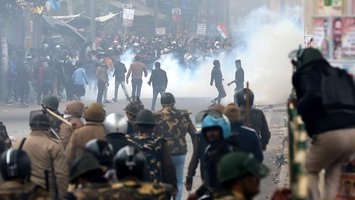
The Citizenship Amendment Act in India is facing protests across the country. As a result, India's Prime Minister Narendra Modi and Home Minister Amit Shah are repeatedly making false claims in favor of the Act.

On Saturday, Home Minister Amit Shah said during a rally in Hubli, Karnataka, "In Afghanistan, the effigy of Buddha was fired from a cannon. He (Hindu-Sikh) was not given the right to contest elections there (Afghanistan-Pakistan), was not given health facilities, did not arrange education for him. All the refugees who were Hindus, Sikhs, Jains, Buddhists and Christians came to seek refuge in India.

In fact, in advocating for the Citizenship Amendment Act, Amit Shah was explaining how Sikhs, Hindu refugees from Afghanistan, Pakistan and Bangladesh are being persecuted in their country and are not being given fundamental rights.

This new law talks about granting citizenship to non-Muslim communities from neighboring Pakistan, Afghanistan and Bangladesh. People are opposing this provision of the Act.

Amit Shah claimed that minorities in Pakistan and Afghanistan cannot contest elections? Is Amit Shah's claim correct? Are minorities in Afghanistan, Pakistan and Bangladesh not allowed to contest elections or vote?

To find out, the BBC tried to understand the electoral rights of minorities in Pakistan, Afghanistan and Bangladesh. At the same time, it was investigated that what rights have been given to them in the electoral process at the present time.

Electoral rights of minorities in Pakistan

According to Article 51 (2A) of the Constitution of Pakistan, 10 seats in the National Assembly, the lower house of the Parliament of Pakistan, are reserved for minorities. In addition, reservation has been given for 23 seats in the assembly of four provinces.

Pakistan has a total of 342 seats and out of which 272 seats are directly elected by the public and send their representatives. 10 seats are reserved for minorities and 60 seats are reserved for women.

There are two ways for minorities to reach Parliament:

These reserved 10 seats are divided by political parties based on how many seats they have won out of 272. The party itself decides the minority candidates on these seats and sends them to Parliament.

Another option is that any minority can contest any seat. In such a situation, his victory will be based on the votes received directly from the public.

Any minority is free to vote for any candidate contesting from their constituency. That is, the right to vote is equal for all.

After independence, the constitution of Pakistan was made in 1956, then it was repealed and the second constitution came in 1958 and it was also repealed and the third constitution was made in 1973 which is still valid. This constitution talks about giving equal rights to minorities in Pakistan.

That is, not only are seats reserved for minorities in Pakistan, they can also contest from other seats.

In the 2018 elections Mahesh Malani, Hariram Kishwari Lal and Gyan Chand Asrani contested from parliamentary and un-reserved seats of assembly from Sindh province and reached Parliament.

What are the electoral rights of Hindu-Sikhs in Afghanistan?

Now talk about Afghanistan. Since 1988, Afghanistan has been the victim of civil war and Taliban violence. The location of the extremist organization al-Qaeda also remained in Afghanistan. In 2002, an interim government was formed and Hamid Karzai became the President. After this, in the elections of 2005, the representatives of the lower house and upper house of the country elected and the parliament of Afghanistan became stronger.

What is the population of Afghanistan? Its exact official data does not exist because the census could not be done here after the 70s. But according to the World Bank, the population here is 3.7 crore.

At the same time, according to the report of the US Department of Justice, in which the number of Hindu-Sikh minorities here are just between 1000 and 1500.

There are 249 seats in the lower house of Afghanistan, ie, where the public directly elects representatives. Minorities have the freedom to contest elections here. But according to the rules, at least 5000 people had to show their support while naming in the parliamentary elections in Afghanistan.

These rules were the same for all but it made it difficult for the minority community to send their representative to the Parliament. Ashraf Ghani came to power in 2014 and has reserved a seat in the lower house, given the equation of Hindu-Sikh minorities.

At this time, Narinder Singh Khalsa MP is on this seat. In addition, a seat in the Upper House of Afghanistan is reserved for religious minorities. Right now, Anarkali Kaur Honyar is the Member of Parliament in this House. These names are decided by the minority community, which are sent directly to Parliament by the President.

Apart from this, any minority can vote for the candidate of his / her constituency. Also, minorities can contest elections from any seat, provided they get the support of five thousand people for themselves.

The BBC spoke to Afghan MP Narinder Singh Khalsa and wanted to know how the minority Sikh-Hindus of Afghanistan have electoral rights?

He said, "Minorities have the freedom to contest elections and also have the freedom to vote. There was never a ban, but in the last thirty years, due to the violence of Taliban, there was a rapid migration and our numbers kept decreasing. Four years ago we got a reserve seat because we could not muster five thousand support. And the matter was heard. We have problems with the Taliban, not the government. Even today, no Hindu-Sikh, whether I vote or my favorite candidate, there is no restriction on the voters. If we gain support, then we can contest elections in more than one seat. ''

The BBC Pashto journalist based in London, Emael Pasharli, says that "a stable government is being formed in the country since 2005". But minorities were never denied the right to vote or contest elections. In the last three decades, not only Hindu-Sikhs, but also those who believe in other religious beliefs have migrated. Civil war has been the reason for this. ''

Any minority can contest elections in Bangladesh

In the parliamentary elections in Bangladesh, seats have not been reserved for any minority community, but only 50 seats have been reserved for women.

Bangladesh Parliament has 350 seats out of which 50 seats are reserved for women. In the 2018 parliamentary elections, out of 79 minority candidates, 18 candidates had reached Parliament.

Earlier, there were similar minority MPs in the 10th Parliament of Bangladesh. According to the local newspaper Dhaka Tribune, 14 MPs in the 9th Parliament of Bangladesh were from the minority community, while eight MPs in the Eighth Parliament were in the minority.

That is, minorities have been given equal electoral rights in Bangladesh politics.

How is reservation in the Indian Parliament different from Pakistan and Afghanistan?

Article 334 (a) of the Constitution of India provides for reservation for Scheduled Castes (Hindus) and Scheduled Tribes (Hindus) in the Lok Sabha and State Legislative Assemblies. Presently, this is the only reservation in the Lok Sabha and the State Legislative Assembly in which seats are reserved for Scheduled Castes (Hindus) and Scheduled Tribes (Hindus). There are no seats reserved for minorities in the Lok Sabha and state assemblies in India.

According to the 1950 notification of the President of India, only Hindu castes would be scheduled castes.

Out of 543 Lok Sabha seats, 79 are reserved for Scheduled Castes (Hindu) and 41 seats for Scheduled Tribes (Hindu). At the same time, out of 3,961 seats in the assemblies, 543 seats are reserved for Scheduled Castes (Hindu) and 527 seats for Scheduled Tribes (Hindus). Everyone votes in these seats, but only the SC or ST candidates.

A reserved seat in India means that the candidate on this seat will be from the scheduled class. All political parties will give tickets to such candidates but their election will be based on the vote of the people.

India does not have a seat reserved for minorities like Pakistan and Afghanistan.

The Modi government abolished two seats reserved for Anglo-Indians in the Lok Sabha, the lower house of Parliament, last year.

Amit Shah claims that minorities cannot contest elections in Pakistan and Afghanistan? His claim is completely untrue.

Why did the Supreme Court refuse to stay the CCA?

In the midst of protests across India on Wednesday, 144 petitions related to the Citizenship Amendment Act (CAA) were heard in the Supreme Court, after which the court said that the CAA cannot be stayed without hearing.

141 petitions were filed against the CAA in court, while three in its favor.

The Supreme Court has said that if they make a constitutional bench, then the same bench will give an interim order.

There is uneasiness and protest among the people about this law In view of that, why did the Supreme Court not stay this law?

In this regard, Faizan Mustafa, constitutional expert and vice-chancellor of Nalasar Law University, Hyderabad, said that it would have been better to see the chaos in the country if the government itself would have told the court that we do not mind that you stay on it Put it, but the government opposed the stay, so the Supreme Court did not stay it.

Faizan Mustafa said, "If the government had agreed to stay on its own today, then all the protests and protests would have ended today."

But the question is, why would the government stand up for its stay? Faizan Mustafa says, "Stay would mean that it will not be implemented until the court decides on hearing it."

He adds, "In cases where the interpretation of the constitution is a matter, stay is rarely found."

At the same time, law expert Alok Prasanna says that what was said in the court today should not be taken to mean that the government is relieved and those who petitioned against the law have been disappointed.

He said, "Nothing has been done yet. The government will have to reply in four weeks."

"The 60 petitions that were filed earlier were against the CAA. Later 80 petitions were filed, many against NPR and some to prevent the CAA from coming into force in Assam. The case has now grown a bit. Therefore, the government's response should also come on other issues raised.

According to Alok Prasanna, no one should be happy or disappointed by today's statement of the court.

He says, "If anyone expected relief today, it was wrong to think like that. The matter has just started.

On the court's decision to dispose of the petitions filed by Assam, Alok Prasanna says, "There is no need to make a deep sense of it. The resentment of the people of Assam is that the CAA deadline is 2014 Which is against the Assam Accord, where the time limit has been kept 1971.''

Experts say that NRC is applicable in Assam, therefore, the separate hearing of its petitions is the right decision.

These petitions have been filed by Congress leaders Jairam Ramesh, Mahua Moitra of Trinamool Congress, Asaduddin Owaisi and many others.

On 9 January, the court expressed displeasure over the violent incidents taking place during the protest against the citizenship law, saying that all the petitions related to the case would be heard only when the violent incidents ceased.

The three-member bench headed by Chief Justice SA Bobde and Justice S Abdul Nazeer and Justice Sanjeev Khanna on these petitions issued notice to the Central Government during the hearing on January 9 and sought reply.

The petitioners have urged the repeal of this law against the basic spirit of the constitution and as divisive.

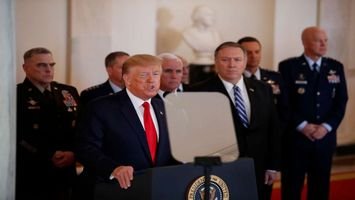
Is Donald Trump scared of Iran's attack?

A drone attack occurred outside Baghdad Airport in the early hours of 3 January. Initial media reports did not see it being linked to any major action. But when the truth came out that Qasim Sulemani, one of Iran's top commanders, was among the dead, it caused panic in the entire Middle East.

After this, US President Donald Trump made it clear by tweeting that Qasim Suleimani had been killed in US action which the US considered 'militant'. Abu Mahdi al-Muhandis, the commander of the Iran-backed militia Qataib Hizbollah, was also killed in the action.

Sulaimani was the head of Iran's Al-Quds Force. Iran's security force is known for its operations outside the country. It was declared a terrorist organization by America.

After this action, tensions in Iran and America reached their peak and they have carried out several missile attacks on the US military base in Iraq, but no American soldiers have been killed in these attacks so far.

The US did not retaliate after the Iranian missile attacks. America's non-action was seen to be linked to many things, the biggest reason being the US general elections due this year.

Experts believe that America will not want to go to war in the election year, but if Iran goes to war then its economy will be destroyed. But the biggest question that arises is whether Iran can influence US elections?

On this, Chintamani Mahapatra, Professor at the Center for Canada, USA and Latin American Studies of Jawaharlal Nehru University, says that the issues of the US presidential election are similar to the elections of other countries. America's economic, social status and foreign policy have a huge impact on this election.

Professor Chintamani Mahapatra says, "In the 2020 presidential elections, Trump will benefit the administration on economic policy, employment and inflation. On the other hand there are social issues. How is social stability and the situation of minorities, how much racism dominates. It Everyone also affects the elections.

If we look at the history of America, then the Presidents have enjoyed the benefit of war or any major action during the presidential elections.

The then President Barack Obama got the benefit of the killing of Al Qaeda chief Osama bin Laden. George Bush Jr. benefited from his second term when he entered Afghanistan. When he went to Afghanistan, there was a message that he is a very strong leader.

During the Second World War, due to the way Franklin D. Roosevelt fought the war, he became the President of America for three consecutive times.

Will Donald Trump benefit from elections in war with Iran? On this question, Professor Chintamani Mahapatra says that foreign and defense policy does not have much impact on elections, but if there is a fight in the time of elections and it involves American soldiers then the issue will come out in the presidential debate. People's support in America's fight against terrorism is supported.

He says, "President Trump will not benefit from America's attack on Iran because political divisions have started in the United States on this issue. The Democratic Party has denied Trump's policy and is non-binding in the House of Representatives." A proposal has been brought which aims to curb the war powers of the President and seek the permission of Congress before starting the war. ''

"But there is a fear in the general public of America that what action will be taken by Iran after Qasim Suleimani is killed? On the other hand, if we look at the European Union countries (Germany, France), they do not support Trump's Iran policy. They want the nuclear deal to remain with Iran. In this perspective, voters who are politically aware and understand international issues, those voters Will vote against Onald Trump. ''

After the death of Qasim Suleimani, Iran has attacked the US airbase several times in Iraq, but the US has not retaliated.

Reports from the Pentagon said that the decision to kill General Suleimani was taken on the spot. Donald Trump has been against the war in the Middle East. During his election campaign for 2015-16, he has said that fighting the war will waste money.

Professor Mukhtar Khan of the University of Delaware, USA, says that one benefit to Donald Trump after killing General Suleimani is that the case of impeachment against him is not getting TV coverage.

He says, "Now the focus of the TV is only on Iran. With this the acceptance of Donald Trump in the Republican Party has gone up to 95%. However, protests in Iran have intensified after the Ukrainian plane was killed. The reason is that Iran may be forced to enter into a new agreement with America. It will be like a victory for America if a stronger agreement than the previous nuclear agreement is reached this time.

"If this agreement is not even done, Trump will try to take advantage of it in the election campaign. He will say that Obama killed Laden but he has killed both Sulemani and Baghdadi. The class that is very concerned about security, say that Trump has a lot to offer. ''

At the same time, Professor Mohapatra says that like Iran, America does not want war because it will not benefit it in elections.

He says, "If an American soldier was killed in Iran's action, the pressure of action would have increased on him and it would also have an impact in American politics that his soldiers were killed because of Trump, so Trump is afraid that Iran will be able to control the circumstances Do not spoil it so that the elections are not affected.

America's war in Iraq and Afghanistan is still going on. The United States believed that its war in Iraq would end in four-five weeks, but in 17 years an estimated two and a half trillion dollars have been spent in it. At the same time, the US debt is 21 trillion dollars, there is a debt on it, but the economic condition of America is quite good.

Professor Muktadar Khan says that only 25 percent of Americans want a war with Iran, while 75 percent want the issue to be resolved through diplomacy or economic sanctions.

He says, "Apart from spending money, on the other hand, America's fear is that Iran will attack back if there is war and could attack Saudi Arabia or UAE. They can destroy their oil wells. Because of this The global economy will come to a standstill. America has one year of oil while Japan and European countries have only one week of oil. If oil exports stop, it will destroy many economies. ''

"At the same time, Iran has a number of militia forces like Hezbollah that can strengthen Iran. It can be understood by this example that if a suicide bomber of these militia army blows himself up in an embassy then by suicide attack Iran will benefit.

Trump of Republican supporters still remains cherished and wants to see him again in the electoral fray. On the other hand, the voting percentage in America is very low as compared to other democratic countries.

Professor Muktadar Khan says that Trump's 43-45% vote is not taking the name of moving, while the opposition is hovering at 53%, out of the total number of people who can vote in the country, only 60% are registered to vote. Only 60 percent of the registered voters vote. If they get half the votes, then a person can become the President of the United States.

He says, "Trump's election result depends on the voting percentage. Democrats will lose Trump if they find a candidate who inspires people to vote. Historically, Conservatives or Republicans are big honest voters who consistently Votes but Democratic voters do not vote consistently. ''

On the other hand, the case of impeachment also does not seem to harm the Trump much in the elections. The impeachment case against Donald Trump is set to fall in the Senate because there is a Republican majority and he stands firmly with Trump. If Trump loses in the Senate, he will have to give up the seat but it is difficult to do so.

Muktadar Khan calls the process of impeachment an initiative of liberal Democrat leaders.

He says, "52-55 percent of Americans hate Trump and hardly hated any other leader. Democrats are doing this to motivate these people to vote. If Democrats don't go ahead on impeachment These voters are not motivated if they grow. Trump also keeps motivating his voters.

How strong will Trump get from a Democrat candidate? It will also decide on the Democrat candidate how he takes his policies to the public. On the other hand, it is not yet clear whether a leader from the Republican Party will challenge Trump.

If no one comes forward to challenge Trump, he will become the Republican candidate himself, being the current President. But the race for the US presidential election is very long and issues and circumstances change from moment to moment in the election process that lasts almost a year.