Magazine

Why is the US leading calls for political change in Lebanon?

Why is the US leading calls for political change in Lebanon?

Saturday, Oct 5, 2024
Lebanon is again under attack as Israel wages war against the country's dominant political and military force - Hezbollah.

Although its primary target is the armed group, Israel's attacks have been indiscriminate, killing civilians and medical workers just as it has done in Gaza.

But the conflict is also bringing pressure to change Lebanon's fragmented political system.

So who is looking for this political change - and what might it mean?

Presenter: Hashem Ahelbarra.
Guests:
Hala Jaber, journalist and author of books on Iraq and Lebanon including 'Hezbollah: Born with a Vengeance'.
Nadim Houry, Executive Director at Arab Reform Initiative and former director of Human Rights Watch.
David Wood, Senior Analyst with International Crisis Group in Beirut.

Inside Western media’s reporting on Gaza

Inside Western media’s reporting on Gaza

Saturday, Oct 5, 2024
When political leaders speak of genocide, they repeat a timeworn mantra: "Never again."

Over the past year, for the Palestinians of Gaza, "again" has become reality - mass casualties broadcast almost in real time by its victims.

This film is about an alternative version of that reality - the one told by major Western news organisations - and how it has provided cover for Israel's war on Gaza.

Based on interviews with more than a dozen insiders, it lifts the curtain on the inner workings of agenda-setting outlets like CNN, the BBC and The New York Times.

Contributors:
"Adam" – journalist, CNN
"Sara" – former journalist, BBC
Ghassan Abu Sitta – reconstructive surgeon
Jodi Rudoren – former Jerusalem bureau chief, The New York Times
Jeremy Scahill – co-founder, Drop Site News
Craig Mokhiber – former senior human rights official, United Nations

Richard Gizbert - Presenter
Daniel Turi – Lead Producer
Monazza Farooqi – Assistant Producer
Haim Litani – Editor
Tariq Nafi – Senior Producer
Meenakshi Ravi – Executive Producer

How Israel and US manufactured the case for genocide in Gaza: Marwan Bishara

How Israel and US manufactured the case for genocide in Gaza: Marwan Bishara

Saturday, Oct 5, 2024
Al Jazeera’s senior political analyst Marwan Bishara highlights that the unfolding events were not driven by instinct or industry foresight, but rather by the daily manufacturing of a case for genocide between October 7, 2023 and October 19, 2023.

Marwan Bishara emphasizes the critical turning point on October 7, when within 12 hours, Hamas delivered a significant blow to Israel, causing deep humiliation. Israel, known for its military strength, was shaken not only by the deaths of hundreds of civilians but also by the loss of soldiers and the violation of its military bases and settlements.

Bishara suggests that these 12 hours of humiliation were followed by 12 days that would shape the subsequent year, during which Israel and the United States began to build the case for genocide.

Support for Israel creates a sense that it can do what it wants: Analysis

Support for Israel creates a sense that it can do what it wants: Analysis

Thursday, Oct 3, 2024
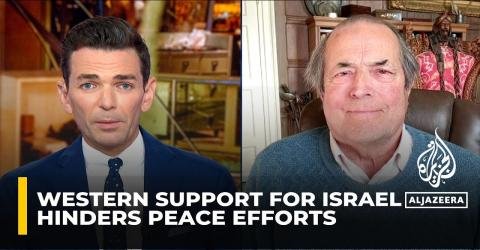
Richard Dalton, a former UK ambassador to Iran, says support for Israel from the West is working against de-escalating the conflict.

"It’s working against establishing a peaceful settlement across the region, whether within Palestine or beyond because it is creating this sense that Israel can do what it wants," he told Al Jazeera.

"They can humiliate the United States. They can bank the military support from the United Kingdom and Israel’s European partners and not do anything to respond to the requirements of those countries that there should be progress towards Palestinian statehood as a prerequisite for peace," he added.

Dalton said that public opinion in the West is turning against Israel due to how it has been fighting its wars.

"I believe that opinion has turned against Israel because of Israel’s action, because of Israel’s denial of basic human rights, because Israel’s denial that rights which it claims for itself should be accorded to others," he said.

Investigating war crimes in Gaza I Al Jazeera Investigations

Investigating war crimes in Gaza I Al Jazeera Investigations

Thursday, Oct 3, 2024  
This feature length investigation by Al Jazeera’s Investigative Unit exposes Israeli war crimes in the Gaza Strip through the medium of photos and videos posted online by Israeli soldiers themselves during the year long conflict.

The I-Unit has built up a database of thousands of videos, photos and social media posts. Where possible it has identified the posters and those who appear.

The material reveals a range of illegal activities, from wanton destruction and looting to the demolition of entire neighbourhoods and murder.

The film also tells the story of the war through the eyes of Palestinian journalists, human rights workers and ordinary residents of the Gaza Strip. And it exposes the complicity of Western governments – in particular the use of RAF Akrotiri in Cyprus as a base for British surveillance flights over Gaza.

"The west cannot hide, they cannot claim ignorance. Nobody can say they didn’t know," says Palestinian writer, Susan Abulhawa.This is "the first livestream genocide in history … If people are ignorant they are wilfully ignorant," she says.

Nobody benefits from such a war: Former Israeli official

Nobody benefits from such a war: Former Israeli official

Thursday, Oct 3, 2024  
At least seven people have been killed and eight wounded in Israeli air strikes targeting central Beirut overnight.

It hit a building in the area of Bachoura - just one kilometre from Lebanon's Parliament and the Prime Minister's office.

Meanwhile, more Israeli strikes have targeted Dahiyeh, the southern suburb of Beirut where Hezbollah leader Hassan Nasrallah was killed last week.

Israel has hit the area several times in the past two weeks, saying it was targeting Hezbollah sites.

And in Gaza, an overnight Israeli strike has killed at least one Palestinian and injured another in Deir el-Balah, in the central part of the strip.

An Israeli helicopter gunship struck a tent housing displaced people in a school compound.

Alon Liel is a former director general at Israel's Foreign Ministry. He was also a former ambassador to South Africa.
 
He says Israel has been weakened from nearly a year of war in Gaza and the prospect of a protracted conflict in the region has its population worried.

US ceasefire talk means nothing while sending Israel weapons: Analysis

US ceasefire talk means nothing while sending Israel weapons: Analysis

Sunday, Sep 29, 2024  #US #JoeBiden #Lebanon
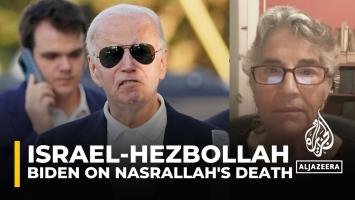
US President Joe Biden has issued a statement on the killing of Nasrallah, calling it "a measure of justice for his many victims, including thousands of Americans, Israelis, and Lebanese civilians".

Biden said the US "fully supports Israel’s right to defend itself against Hezbollah, Hamas, the Houthis, and any other Iranian-supported terrorist groups".

Biden added that his government was enhancing "the defense posture of U.S. military forces in the Middle East region to deter aggression and reduce the risk of a broader regional war".

Al Jazeera’s Shihab Rattansi has more on the US reaction from Washington, DC.

Phyllis Bennis is a fellow with the Institute for Policy Studies. She says the Biden administration's efforts to secure a ceasefire are undermined by their continual supply of weapons to Israel.

Tumultuous history of Hezbollah will the party survive the death of powerful leader?

Tumultuous history of Hezbollah will the party survive the death of powerful leader?

Sunday, Sep 29, 2024  #HassanNasrallah #Hezbollah #MiddleEastConflict
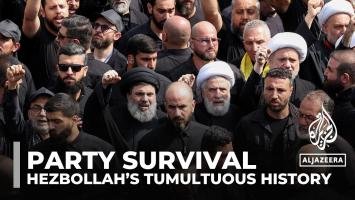
Israel’s assassination of Hezbollah leader Hassan Nasrallah has sent shockwaves through the Shia militant organization. Seen as one of the most critical blows to Hezbollah, the killing comes after decades of clashes between the Iran-backed group and Israel.

Al Jazeera’s Mohamed Vall reports.

31 people killed in Russian attack on Ukraine, children's hospital also attacked

31 people killed in Russian attack on Ukraine, children's hospital also attacked

Monday, 8 July 2024

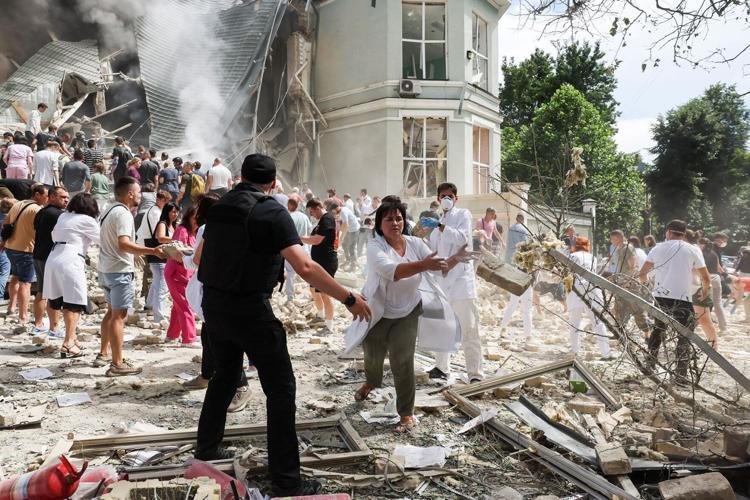
31 people have died and more than 150 have been injured in Russia's latest attacks on Ukraine. 17 people have been killed in the capital Kiev alone. Of these 17 deaths, two have died in a children's hospital. 11 deaths have occurred in several attacks in Dnipropetrovsk. Nothing is known about where the rest of the people were killed.

Ohmetidiyat Hospital has also come under the Russian attack. At the time of the attack, 20 children were being treated in the children's ward of the hospital.

Heavy damage can be seen in the pictures of the children's hospital.

Ukrainian President Volodymyr Zelensky is on a visit to Poland. Where he is likely to sign security agreements. Zelensky said that 40 missiles were fired at several cities, including Kiev and Sloviansk.

Residential buildings, buildings and children's hospitals have been damaged in these attacks. Smoke can be seen all over the city of Kiev.

At the same time, the damage caused to the Ohmetidiyat hospital by the attack can be seen in several videos posted on social media.

Zelensky said in a social media post that people were trapped under the rubble of the hospital. At present, doctors, nurses and common people are also trying to remove the rubble.

Bihar caste survey: 17.7 percent Muslims; How many Hindus, Buddhists and Sikhs are there?

In India, Nitish government of Bihar has released the caste survey data today. Data related to religion was also collected during the survey and information about this has also been given.

The largest population in Bihar is of those who follow Hindu religion. After them are the number of people following Muslim religion. However, there is a huge gap between the populations of followers of both the religions.

The caste survey conducted in Bihar has revealed that out of about 13 crore people of the state, there are 2146 people who do not have any religion.

How many people of which religion are there in Bihar?

Hindu: 81.99 percent

Muslims: 17.70 percent

Christians: 0.057 percent

Sikh: 0.0113 percent

Buddhist: 0.085 percent

Jain: 0.009 percent